
|
You entered: cassini spacecraft
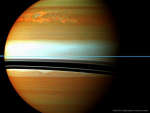 A Long Storm System on Saturn
15.09.2019
It was one of the largest and longest lived storms ever recorded in our Solar System. First seen in late 2010, the above cloud formation in the northern hemisphere of Saturn started larger than the Earth and soon spread completely around the planet.
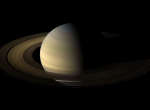 Saturn at Equinox
21.09.2014
How would Saturn look if its ring plane pointed right at the Sun? Before August 2009, nobody knew. Every 15 years, as seen from Earth, Saturn's rings point toward the Earth and appear to disappear.
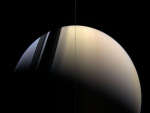 Saturn in Blue and Gold
13.04.2014
Why is Saturn partly blue? The above picture of Saturn approximates what a human would see if hovering close to the giant ringed world. The above picture was taken in 2006 March by the robot Cassini spacecraft now orbiting Saturn. Here Saturn's majestic rings appear directly only as a thin vertical line.
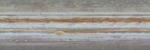 Jupiter Unpeeled
15.02.2001
Slice Jupiter from pole to pole, peel back its outer layers of clouds, stretch them onto a flat surface ... and for all your trouble you'd end up with something that looks a lot like this. Scrolling right will reveal the full picture, a color mosaic of Jupiter from the Cassini spacecraft.
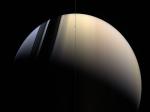 Saturn in Blue and Gold
3.05.2006
Why is Saturn partly blue? The above picture of Saturn approximates what a human would see if hovering close to the giant ringed world. The above picture was taken in mid-March by the robot Cassini spacecraft now orbiting Saturn. Here Saturn's majestic rings appear directly only as a thin vertical line.
 A Wavemaker Moon in Saturns Rings
23.05.2005
What causes small waves in Saturn's rings? Observations of rings bordering the Keeler gap in Saturn's rings showed unusual waves. Such waves were first noticed last July and are shown above in clear detail.
 Propeller Shadows on Saturns Rings
26.10.2016
What created these unusually long shadows on Saturn's rings? The dark shadows -- visible near the middle of the image -- extend opposite the Sun and, given their length, stem from objects having heights up to a few kilometers.
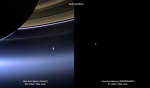 APOD: 2026 June 13 Б Interplanetary Earth
13.06.2026
In an interplanetary first, on July 19, 2013 Earth was photographed on the same day from two other worlds of the Solar System, innermost planet Mercury and ringed gas giant Saturn. Pictured...
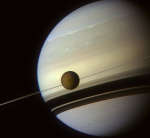 In the Shadow of Saturns Rings
3.07.2012
Humanity's robot orbiting Saturn has recorded yet another amazing view. That robot, or course, is the spacecraft Cassini, while the new amazing view includes a bright moon, thin rings, oddly broken clouds, and warped shadows. Titan, Saturn's largest moon, appears above as a featureless tan as it is continually shrouded in thick clouds.
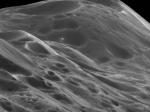 4000 Kilometers Above Saturns Iapetus
19.09.2007
What does the surface of Saturn's mysterious moon Iapetus look like? To help find out, the robotic Cassini spacecraft now orbiting Saturn was sent soaring last week just 2,000 kilometers from the unique equatorial ridge of the unusual walnut-shaped two-toned moon.
|
January February March April May June July August September October |
|||||||||||||||||||||||||||||||||||||||||||||||||