
|
You entered: comet tail
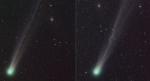 Comet C 2001 Q4 (NEAT)
23.04.2004
Inbound from the distant solar system, comet C/2001 Q4 will soon pass just inside planet Earth's orbit and should be one of two bright, naked-eye comets visible in southern skies in May. First...
 APOD: 2023 September 3 Б Comet Schwassmann Wachmann 3 Fragments
3.09.2023
Periodic comet 73P/Schwassmann-Wachmann 3 has broken up at least twice. A cosmic souffle of ice and dust left over from the early solar system, this comet was first seen to split into several large pieces during the close-in part of its orbit in 1995.
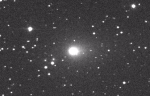 Hyakutake: The Great Comet of 1996?
8.02.1996
Get ready for one of the most impressive but least anticipated light shows in modern astronomical history. Next month, newly discovered Comet Hyakutake will pass closer to the Earth than any recent comet. Unknown...
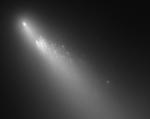 Schwassmann Wachmann 3: Fragment B
4.05.2006
Periodic comet 73P/Schwassmann-Wachmann 3 has fallen apart before. A cosmic souffle of ice and dust left over from the early solar system, this comet was seen to split into several large pieces during the close-in part of its orbit in 1995.
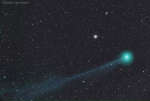 Comet Lovejoy before a Globular Star Cluster
30.12.2014
Comet Lovejoy has become visible to the unaided eye. To see the comet, just go outside an hour or so after sunset and look for a fuzzy patch to the right of Orion's belt. Binoculars and a star chart may help.
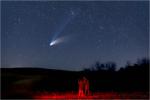 Hale Bopp: The Great Comet of 1997
31.03.2007
Ten short years ago, Comet Hale-Bopp rounded the Sun and offered a dazzling spectacle in planet Earth's night. This stunning view, recorded shortly after the comet's perihelion passage on April 1, 1997, features the memorable tails of Hale-Bopp -- a whitish dust tail and blue ion tail.
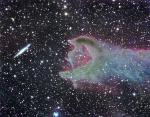 CG4: A Ruptured Cometary Globule
13.10.2002
The odd looking "creature" to the right of center in the above photo is a gas cloud known as a cometary globule. This globule, however, has ruptured. Cometary globules are typically characterized by dusty heads and elongated tails.
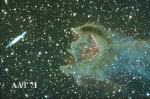 CG4: A Ruptured Cometary Globule
6.12.1998
The odd looking "creature" to the right of center in the above photo is a gas cloud known as a cometary globule. This globule, however, has ruptured. Cometary globules are typically characterized by dusty heads and elongated tails.
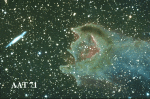 CG4: A Ruptured Cometary Globule
28.12.1996
The odd looking "creature" to the right of center in the above photo is a gas cloud known as a cometary globule. This globule, however, has ruptured. Cometary globules are typically characterized by dusty heads and elongated tails.
 APOD: 2025 October 20 Б Finding Comet Lemmon
20.10.2025
Tonight, if you can see the stars of the Big Dipper, then you can find comet Lemmon in your evening sky. After sunset, look for the faint but extended comet above your northwestern horizon -- but below the handle of the famous celestial kitchen utensil of the north.
|
January February March April May June July August September |
|||||||||||||||||||||||||||||||||||||||||||||||||