
|
You entered: light
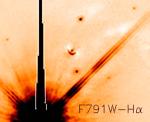 Diffraction Spikes: When Stars Look Like Crosses
19.11.1997
Unusual appendages around bright stars are commonplace, but never seem to be mentioned. What are they? First, a telescope brings starlight falling over a large area to a small area. To get at this...
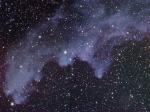 IC 2118: The Witch Head Nebula
27.12.2005
Double, double toil and trouble; Fire burn, and cauldron bubble -- maybe Macbeth should have consulted the Witch Head Nebula. This suggestively shaped reflection nebula is associated with the bright star Rigel in the constellation Orion.
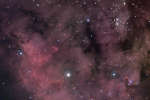 The Star Pillars of Sharpless 171
18.10.2009
Towering pillars of cold gas and dark dust adorn the center star forming region of Sharpless 171. An open cluster of stars is forming there from the gas in cold molecular clouds. As energetic...
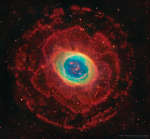 Rings Around the Ring Nebula
18.08.2021
The Ring Nebula (M57), is more complicated than it appears through a small telescope. The easily visible central ring is about one light-year across, but this remarkably deep exposure - a collaborative effort combining data from three different large telescopes - explores the looping filaments of glowing gas extending much farther from the nebula's central star.
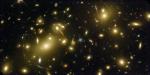 Abell 2218: A Galaxy Cluster Lens
1.02.2000
Gravity can bend light. Almost all of the bright objects in this recently released Hubble Space Telescope image are galaxies in the cluster known as Abell 2218. The cluster is so massive and so compact that its gravity bends and focuses the light from galaxies that lie behind it.
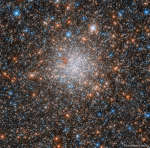 APOD: 2025 December 28 Б NGC 1898: Globular Cluster in the Large Magellanic Cloud
28.12.2025
Jewels don't shine this bright -- only stars do. And almost every spot in this jewel-box of an image from the Hubble Space Telescope is a star. Now, some stars are more red than our Sun, and some more blue -- but all of them are much farther away.
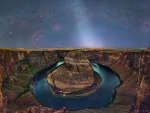 A Zodiacal Sky over Horseshoe Bend
22.05.2017
What's causing the unusual ray of white light extending upward from the central horizon? Dust orbiting the Sun. At certain times of the year, a band of sun-reflecting dust from the inner Solar System rises prominently before sunrise and is called zodiacal light.
 APOD: 2024 April 28 Б Rings Around the Ring Nebula
28.04.2024
The Ring Nebula (M57) is more complicated than it appears through a small telescope. The easily visible central ring is about one light-year across, but this remarkably deep exposure - a collaborative effort combining data from three different large telescopes - explores the looping filaments of glowing gas extending much farther from the nebula's central star.
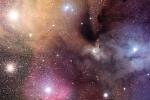 The Colorful Clouds of Rho Ophiuchi
3.09.2007
The many spectacular colors of the Rho Ophiuchi (oh'-fee-yu-kee) clouds highlight the many processes that occur there. The blue regions shine primarily by reflected light. Blue light from the star Rho Ophiuchi and nearby stars reflects more efficiently off this portion of the nebula than red light.
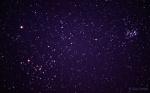 Saturn and Vesta in Taurus
18.01.2002
Last November, while skygazing toward the constellation Taurus, astrophotographer Joe Orman arranged this time exposure to include the lovely Hyades and Pleiades star clusters in the field of his telephoto lens. A distance...
|
January February March April May June July August September October |
|||||||||||||||||||||||||||||||||||||||||||||||||