
|
You entered: pole
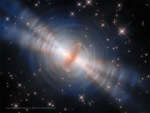 APOD: 2026 February 25 Б The Egg Nebula from the Hubble Telescope
25.02.2026
Ever wonder what it would look like to crack open the Sun? The Egg Nebula, a dying Sun-like star, can unscramble this question. Pictured is a combination of several visible and infrared images of the nebula (also known as RAFGL 2688 or CRL 2688) taken with the Hubble Space Telescope.
 Jupiter s Clouds from New Horizons
15.10.2007
The New Horizons spacecraft took some stunning images of Jupiter earlier this year while on the way out to Pluto. Famous for its Great Red Spot, Jupiter is also known for its regular, equatorial cloud bands, visible through even modest sized telescopes.
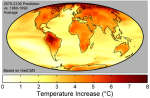 Global Warming Predictions
21.04.2009
How much will the Earth's surface warm up over the lives of our children? No one is sure. Compared to the past 100 million years, the Earth is currently enduring a relative cold spell, possibly about four degrees Celsius below average.
 Mars Opposition
27.07.2018
Look opposite the Sun in the sky tonight and you'll see Mars at its brightest. Also within days of its closest approach Mars rises at sunset, near its brightest and best for telescopic observers too, except for the dust storm still blanketing the Red Planet.
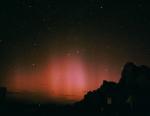 Aurora In West Texas Skies
15.09.2000
The aurora borealis, or northern lights, are not a common sight in the southwestern United States. But a strong solar coronal mass ejection in early August triggered geomagnetic storms and aurora which were widely reported, even under west Texas skies.
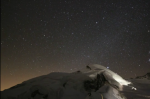 Geostationary Satellites Beyond the Alps
11.04.2012
Why don't those stars move? Stars in the sky will typically appear to rise and set as the Earth turns. Those far to the north or south will appear to circle the pole. If you look closely at the above time-lapse movie, however, there are points of light that appear stationary.
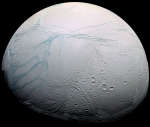 Fresh Tiger Stripes on Saturns Enceladus
6.04.2014
Do underground oceans vent through the tiger stripes on Saturn's moon Enceladus? Long features dubbed tiger stripes are known to be spewing ice from the moon's icy interior into space, creating a cloud of fine ice particles over the moon's South Pole and creating Saturn's mysterious E-ring.
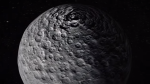 Fly Over Dwarf Planet Ceres
10.06.2015
What would it look like to fly over dwarf planet Ceres? Animators from the German Aerospace Center recently took actual images and height data from NASA's robotic Dawn mission -- currently visiting Ceres -- to generate several fascinating virtual sequences.
 Gemini Observatory North
15.10.2016
It does look like a flying saucer, but this technologically advanced structure is not here to deliver the wise extraterrestrial from the scifi classic movie The Day the Earth Stood Still. It is here to advance our knowledge of the Universe though.
 A Season of Saturn
25.08.2023
Ringed planet Saturn will be at its 2023 opposition, opposite the Sun in Earth's skies, on August 27. While that puts the sixth planet from the Sun at its brightest and well-placed for viewing, its beautiful ring system isn't visible to the unaided eye.
|
January February March April May June July August |
||||||||||||||||||||||||||||||||||||||||||||||||||||||||