
|
You entered: space
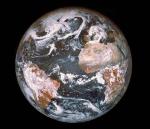 An Earth Ornament
25.12.1999
The Apollo 8 astronauts spent the 1968 Christmas Season orbiting the Moon, returning with striking images of both Moon and Earth from space - pictures which inspired the world. While in lunar orbit...
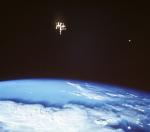 The Moons Of Earth
27.01.2001
While orbiting the planet during their June 1998 mission, the crew of the Space Shuttle Discovery photographed this view of two moons of Earth. Thick storm clouds are visible in the lovely blue planet...
 The Crew 7 Nebula
31.08.2023
Not the James Webb Space Telescope's latest view of a distant galactic nebula, this illuminated cloud of gas and dust dazzled early morning spacecoast skygazers on August 26. The snapshot was taken about...
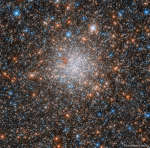 APOD: 2025 December 28 Б NGC 1898: Globular Cluster in the Large Magellanic Cloud
28.12.2025
Jewels don't shine this bright -- only stars do. And almost every spot in this jewel-box of an image from the Hubble Space Telescope is a star. Now, some stars are more red than our Sun, and some more blue -- but all of them are much farther away.
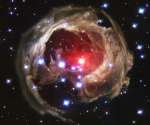 Light Echoes from V838 Mon
4.12.2011
For reasons unknown, star V838 Mon's outer surface suddenly greatly expanded with the result that it became the brightest star in the entire Milky Way Galaxy in January 2002. Then, just as suddenly, it faded. A stellar flash like this has never been seen before.
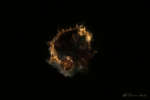 A Falcon 9 Nebula
4.09.2021
Not the Hubble Space Telescope's latest view of a distant galactic nebula, this illuminated cloud of gas and dust dazzled early morning spacecoast skygazers on August 29. The snapshot was taken at 3:17am from Space View Park in Titusville, Florida.
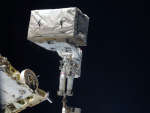 Astronauts Head Upgraded During Spacewalk
1.04.2009
First, a new truss was added. Then, new solar panels were installed. Now, as part of the planned upgrade of the International Space Station, an Expedition 18 astronaut has upgraded her own head.
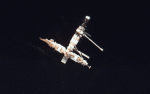 Atlantis Approaches Mir
2.04.1996
Imagine flying though space and approaching the Mir space station. The crew of the Space Shuttle Atlantis did just this in a mission that ended only two days ago. Mir, now 10 years old, is equipped for scientific experiments in astronomy, physics, materials, biology and chemistry.
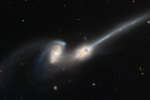 NGC 4676: When Mice Collide
26.04.2009
These two mighty galaxies are pulling each other apart. Known as "The Mice" because they have such long tails, each spiral galaxy has likely already passed through the other. They will probably collide again and again until they coalesce.
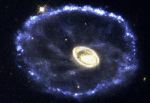 The Cartwheel Galaxy
2.07.1995
The Cartwheel Galaxy shows a ring that is the result of a collision between a small and a large galaxy. After a small galaxy has moved through a big galaxy - in this case...
|
January February March April May June July August September October |
|||||||||||||||||||||||||||||||||||||||||||||||||