
|
You entered: universe
 Confirmed Muon Wobble Remains Unexplained
13.04.2021
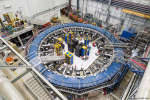
How fast do elementary particles wobble? A surprising answer to this seemingly inconsequential question came out of Brookhaven National Laboratory in New York, USA in 2001, and indicated that the Standard Model of Particle Physics, adopted widely in physics, is incomplete.
 APOD: 2023 May 31 Б Simulation: A Disk Galaxy Forms
31.05.2023
How did we get here? We know that we live on a planet orbiting a star orbiting a galaxy, but how did all of this form? Since our universe moves too slowly to watch, faster-moving computer simulations are created to help find out.
 Abell 1795: A Galaxy Cluster s Cooling Flow
8.12.2000
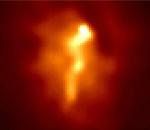
Throughout the Universe, galaxies tend to swarm in groups ranging from just a handful of members to casts of thousands. Astronomers have realized since the early 1970s that the larger swarms, immense clusters of galaxies millions of light-years across, are immersed within tenuous clouds of hot gas which glow strongly in x-rays.
 The Farthest Explosion Yet Measured
19.10.2000
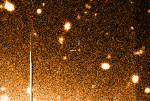
It happened so far away that common human distance measures are inadequate to describe it. Furthermore, astronomers do not even claim to know exactly what happened. What is known is that satellites across our Solar System reported on 2000 January 31 a tremendous explosion of gamma rays had occurred towards some previously uninteresting direction.
 APOD: 2025 June 4 Б A Milky Road to the Rubin Observatory
4.06.2025
Is the sky the same every night? No -- the night sky changes every night in many ways. To better explore how the night sky changes, the USA's NSF and DOE commissioned the Vera C. Rubin Observatory in Cerro PachцЁn, Chile.
 Gamma Ray Bursting
4.11.1999
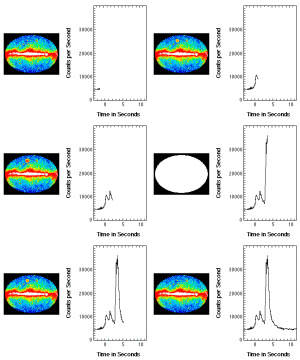
Using graphics and data from NASA's Compton Gamma Ray Observatory, this animation illustrates one of the most exciting mysteries of modern astrophysics, gamma-ray bursts. Incredibly gamma-ray bursts, sudden flashes of radiation with over 100,000 times the energy of visible light photons, occur several times a day.
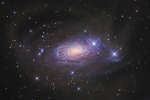 Star Streams and the Sunflower Galaxy
11.09.2010
A bright spiral galaxy of the northern sky, Messier 63 is about 25 million light-years distant in the loyal constellation Canes Venatici. Also cataloged as NGC 5055, the majestic island universe is nearly 100,000 light-years across, about the size of our own Milky Way.
 APOD: 2023 September 6 Б HESS Telescopes Explore the High Energy Sky
6.09.2023
They may look like modern mechanical dinosaurs, but they are enormous swiveling eyes that watch the sky. The High Energy Stereoscopic System (H.E.S.S.) Observatory is composed of four 12-meter reflecting-mirror telescopes surrounding a larger telescope housing a 28-meter mirror.
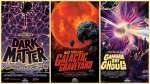 A Galaxy of Horrors
31.10.2020
Explore extreme and terrifying realms of the Universe tonight. If you dare to look, mysterious dark matter, a graveyard galaxy, zombie worlds, and gamma-ray bursts of doom are not all that awaits. Just follow the link and remember, it's all based on real science, even the scary parts. Have a safe and happy halloween!
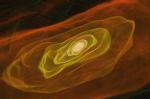 Zooming in on the First Stars
10.06.2003
What became of the first stars? No known stars appear to be composed of truly primordial gas -- all of the stars around us have too many heavy elements. Our own Sun is thought to be a third generation star, with many second-generation stars seen in globular clusters.
|
January February March April May June July August September October |
|||||||||||||||||||||||||||||||||||||||||||||||||