
|
You entered: young stars
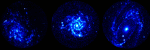 A Spiral Galaxy Gallery
9.04.1996
A progression of beautiful spiral galaxies is illustrated above with three photographs from NASA's Ultraviolet Imaging Telescope (UIT). Flying above the Earth's obscuring layer of atmosphere on the Space Shuttle Columbia during...
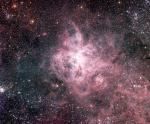 The Tarantula Zone
13.06.2002
The Tarantula Nebula is more than 1,000 light-years across - a giant emission nebula within our neighboring galaxy the Large Magellanic Cloud. Inside this cosmic arachnid lies a central young cluster of massive stars, cataloged as R136, whose intense radiation and strong winds have helped energize the nebular glow and shape the spidery filaments.
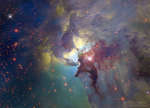 The Lively Center of the Lagoon Nebula
24.05.2022
The center of the Lagoon Nebula is a whirlwind of spectacular star formation. Visible near the image center, at least two long funnel-shaped clouds, each roughly half a light-year long, have been formed by extreme stellar winds and intense energetic starlight. A tremendously bright nearby star, Herschel 36, lights the area.
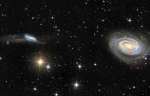 Arp 159 and NGC 4725
2.09.2015
Pointy stars and peculiar galaxies span this cosmic snapshot, a telescopic view toward the well-groomed constellation Coma Berenices. Bright enough to show off diffraction spikes, the stars are in the foreground of the scene, well within our own Milky Way. But the two prominent galaxies lie far beyond our own, some 41 million light-years distant.
 APOD: 2025 June 24 Б In the Center of Spiral Galaxy M61
23.06.2025
Is there a spiral galaxy in the center of this spiral galaxy? Sort of. Image data from the Hubble Space Telescope, the European Southern Observatory, and smaller telescopes on planet Earth are combined in this detailed portrait of face-on spiral galaxy Messier 61 (M61) and its bright center.
 M81 in True Color
14.07.1996
Here's what a spiral galaxy REALLY looks like. Yesterday, M81 was shown in two colors only, but here we see M81 at its most colorful. In the above picture, note how blue the spiral arms are - this indicates the presence of hot young stars and on-going star formation.
 NGC 253: Dusty Island Universe
21.03.2018
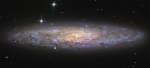
Shiny NGC 253 is one of the brightest spiral galaxies visible, and also one of the dustiest. Some call it the Silver Dollar Galaxy for its appearance in small telescopes, or just the Sculptor Galaxy for its location within the boundaries of the southern constellation Sculptor.
 Massive Nearby Spiral Galaxy NGC 2841
21.04.2014
It is one of the more massive galaxies known. A mere 46 million light-years distant, spiral galaxy NGC 2841 can be found in the northern constellation of Ursa Major. This sharp view of the gorgeous island universe shows off a striking yellow nucleus and galactic disk.
 Massive Nearby Spiral Galaxy NGC 2841
27.04.2015
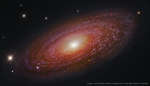
It is one of the more massive galaxies known. A mere 46 million light-years distant, spiral galaxy NGC 2841 can be found in the northern constellation of Ursa Major. This sharp view of the gorgeous island universe shows off a striking yellow nucleus and galactic disk.
 Massive Nearby Spiral Galaxy NGC 2841
23.01.2021
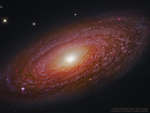
It is one of the more massive galaxies known. A mere 46 million light-years distant, spiral galaxy NGC 2841 can be found in the northern constellation of Ursa Major. This sharp view of the gorgeous island universe shows off a striking yellow nucleus and galactic disk.
|
January February March April May June July August September October |
|||||||||||||||||||||||||||||||||||||||||||||||||