
|
You entered: sky
 Cat s Eye Wide and Deep
25.05.2023
The Cat's Eye Nebula (NGC 6543) is one of the best known planetary nebulae in the sky. Its more familiar outlines are seen in the brighter central region of the nebula in this impressive wide-angle view. But this wide and deep image combining data from two telescopes also reveals its extremely faint outer halo.
 Milky Way Rising
1.12.2023
The core of the Milky Way is rising beyond the Chilean mountain-top La Silla Observatory in this deep night skyscape. Seen toward the constellation Sagittarius, our home galaxy's center is flanked...
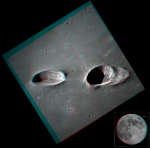 APOD: 2026 May 9 Б Messier Craters in Stereo
9.05.2026
Many bright nebulae and star clusters in planet Earth's sky are associated with the name of astronomer Charles Messier from his famous 18th century catalog. His name is also given to these two large and remarkable craters on the Moon.
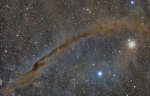 APOD: 2026 July 31 Б NGC 4372 and the Dark Doodad
31.07.2026
The Dark Doodad Nebula drifts through southern skies, a tantalizing target for binoculars toward the small constellation Musca, The Fly. A dusty interstellar cloud, it's seen against rich starfields just south of the Coalsack Nebula and the Southern Cross.
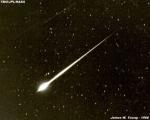 A Leonid Fireball From 1966
13.11.1998
This bright fireball meteor was photographed from Table Mountain Observatory during the peak of the annual Leonid meteor shower on November 17, 1966. That was a good year for Leonid meteor watchers - a meteor "storm" was produced as the Earth swept through a dense swarm of dusty debris from the tail of comet Tempel-Tuttle.
 The Compton Observatory Turns Five
13.04.1996
Earlier this April, NASA's Compton Gamma Ray Observatory, completed its fifth successful year in orbit, exploring the gamma ray sky. Pictured is astronaut Jay Apt perched in the shuttle payload bay below the massive observatory. Compton is the largest civilian instrument ever flown - the whole observatory is roughly the size of a school bus.
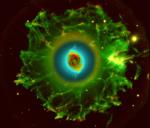 Halo of the Cat's Eye
4.09.2002
The Cat's Eye Nebula (NGC 6543) is one of the best known planetary nebulae in the sky. Its haunting symmetries are seen in the very central region of this stunning false-color picture, processed...
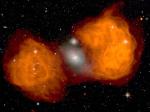 The Giant Radio Lobes of Fornax A
28.06.2005
Together, the radio lobes span over one million light years -- what caused them? In the center is a large but peculiar elliptical galaxy dubbed NGC 1316. Detailed inspection of the NGC 1316 system indicates that it began absorbing a small neighboring galaxy about 100 million years ago.
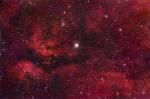 Central Cygnus
4.01.2007
Supergiant star Gamma Cygni lies at the center of the Northern Cross, famous asterism in the constellation Cygnus the Swan. Known by the proper name Sadr, the bright star also lies at the center...
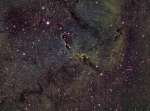 The Elephant s Trunk in IC 1396
26.12.2008
(xxxedit and linkxxx) Like an illustration in a galactic Just So Story, the Elephant's Trunk Nebula winds through the emission nebula and young star cluster complex IC 1396, in the high and far off constellation of Cepheus. Of course, this cosmic elephant's trunk is over 20 light-years long.
|
January February March April May June July August September October |
|||||||||||||||||||||||||||||||||||||||||||||||||