
|
You entered: black hole
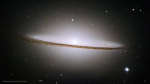 The Sombrero Galaxy from Hubble
26.07.2015
Why does the Sombrero Galaxy look like a hat? Reasons include the Sombrero's unusually large and extended central bulge of stars, and dark prominent dust lanes that appear in a disk that we see nearly edge-on. Billions of old stars cause the diffuse glow of the extended central bulge.
 Unusual Gas Filaments Surround Galaxy NGC 1275
25.07.2005
How were the unusual gas filaments surrounding galaxy NGC 1275 created? No one is sure. Galaxy NGC 1275 is the central dominant galaxy of the Perseus Cluster of Galaxies, a cluster with many member galaxies visible in the above image. In visible light, NGC 1275 appears to show a spectacular collision between two distinct galaxies.
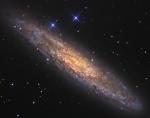 NGC 253: Dusty Island Universe
21.04.2006
Shiny NGC 253, sometimes called the Silver Dollar Galaxy, is one of the brightest spiral galaxies visible - and also one of the dustiest. First swept up in 1783 by mathematician and astronomer Caroline Herschel, the dusty island universe lies a mere 10 million light-years away in the southern constellation Sculptor.
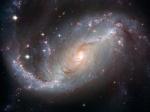 Barred Spiral Galaxy NGC 1672
18.04.2007
Many spiral galaxies have bars across their centers. Even our own Milky Way Galaxy is thought to have a modest central bar. Prominently barred spiral galaxy NGC 1672, pictured above, was captured in spectacular detail in this recently released image taken by the orbiting Hubble Space Telescope.
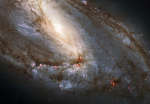 Messier 66 Close Up
13.06.2024
Big, beautiful spiral galaxy Messier 66 lies a mere 35 million light-years away. The gorgeous island universe is about 100 thousand light-years across, similar in size to the Milky Way. This Hubble Space Telescope close-up view spans a region about 30,000 light-years wide around the galactic core.
 Grand Spiral NGC 5643
26.12.2024
Viewed face-on, grand spiral galaxy NGC 5643 has a festive appearance in this colorful cosmic portrait. Some 55 million light-years distant, the galaxy extends for over 100,000 light-years, seen within the boundaries of the southern constellation Lupus.
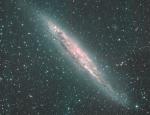 Nearby Spiral Galaxy NGC 4945
21.07.2002
For such a close galaxy, NGC 4945 is easy to miss. NGC 4945 is a spiral galaxy in the Centaurus Group of galaxies, located only six times farther away than the prominent Andromeda Galaxy. The thin disk galaxy is oriented nearly edge-on, however, and shrouded in dark dust.
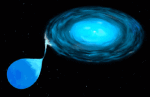 Accretion Disk Binary System
26.12.1995
Our Sun is unusual in that it is alone - most stars occur in multiple or binary systems. In a binary system, the higher mass star will evolve faster and will eventually become a compact object - either a white dwarf star, a neutron star, or black hole.
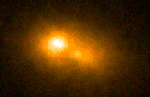 The Double Nucleus of M31
11.10.1996
The center of M31 is twice as unusual as previously thought. In 1991 the Planetary Camera then onboard the Hubble Space Telescope pointed toward the center of our Milky Way's closest major galactic neighbor: Andromeda (M31). To everyone's surprise, M31's nucleus showed a double structure.
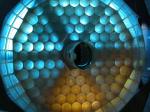 SOFIA s Mirror
22.10.2004
The candy-dish appearance of this high-tech astronomical mirror is striking. Made of a special glass ceramic material called Zerodur, it actually measures 2.7 meters across. The transparent surface has not yet received a reflective...
|
January February March April May June July August September October |
|||||||||||||||||||||||||||||||||||||||||||||||||