
|
You entered: comet tail
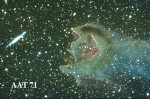 CG4: A Ruptured Cometary Globule
4.10.1995
The odd looking "creature" to the right of center in the above photo is a gas cloud known as a cometary globule. This globule, however, has ruptured. Cometary globules are typically characterized by dusty heads and elongated tails.
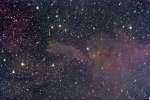 CG4: A Ruptured Cometary Globule
1.09.2008
Can a gas cloud grab a galaxy? It's not even close. The "claw" of this odd looking "creature" in the above photo is a gas cloud known as a cometary globule. This globule, however, has ruptured. Cometary globules are typically characterized by dusty heads and elongated tails.
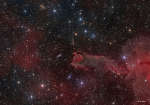 CG4: A Ruptured Cometary Globule
25.07.2021
Can a gas cloud grab a galaxy? It's not even close. The "claw" of this odd looking "creature" in the featured photo is a gas cloud known as a cometary globule. This globule, however, has ruptured. Cometary globules are typically characterized by dusty heads and elongated tails.
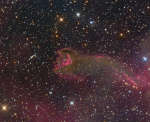 CG4: A Ruptured Cometary Globule
13.05.2014
Can a gas cloud grab a galaxy? It's not even close. The "claw" of this odd looking "creature" in the above photo is a gas cloud known as a cometary globule. This globule, however, has ruptured. Cometary globules are typically characterized by dusty heads and elongated tails.
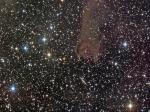 CG4: A Ruptured Cometary Globule
6.08.2007
Can a gas cloud eat a galaxy? It's not even close. The odd looking "creature" or "hand" extending down from the top of the above photo is a gas cloud known as a cometary globule. This globule, however, has ruptured. Cometary globules are typically characterized by dusty heads and elongated tails.
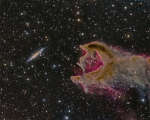 APOD: 2023 January 4 Б CG4: The Globule and the Galaxy
3.01.2023
Can a gas cloud eat a galaxy? It's not even close. The "claw" of this odd looking "creature" in the featured photo is a gas cloud known as a cometary globule. This globule, however, has ruptured. Cometary globules are typically characterized by dusty heads and elongated tails.
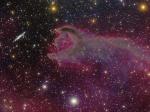 CG4: A Ruptured Cometary Globule
13.03.2006
Can a gas cloud eat a galaxy? It's not even close. The odd looking "creature" in the center of the above photo is a gas cloud known as a cometary globule. This globule, however, has ruptured. Cometary globules are typically characterized by dusty heads and elongated tails.
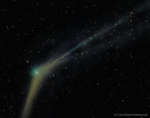 Comet Catalina Emerges
6.12.2015
Comet Catalina is ready for its close-up. The giant snowball from the outer Solar System, known formally as C/2013 US10 (Catalina), rounded the Sun last month and is now headed for its closest approach to Earth in January.
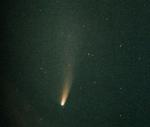 Comet NEAT in Southern Skies
5.03.2003
After last month's dramatic swoop past the Sun, Comet NEAT (C/2002 V1) appeared as a naked-eye comet, emerging from the evening twilight in planet Earth's southern skies. On March 1st, New Zealand...
 APOD: 2024 May 21 Б CG4: The Globule and the Galaxy
20.05.2024
Can a gas cloud eat a galaxy? It's not even close. The "claw" of this odd looking "creature" in the featured photo is a gas cloud known as a cometary globule. This globule, however, has ruptured. Cometary globules are typically characterized by dusty heads and elongated tails.
|
January February March April May June July August September |
|||||||||||||||||||||||||||||||||||||||||||||||||