
|
You entered: meteor shower
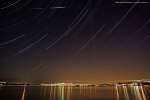 Perseid over Vancouver
16.08.2008
Colorful and bright, the city lights of Vancouver, Canada are reflected in the water in this portrait of the world at night. Recorded on August 12 during the Perseid Meteor Shower, the wide-angle view takes in a large swath along the photographer's eastern horizon.
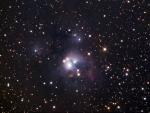 Young Suns of NGC 7129
11.08.2005
Young suns still lie within dusty NGC 7129, some 3,000 light-years away toward the royal constellation Cepheus. While these stars are at a relatively tender age, only about a million years old, it is likely that our own Sun formed in a similar stellar nursery some five billion years ago.
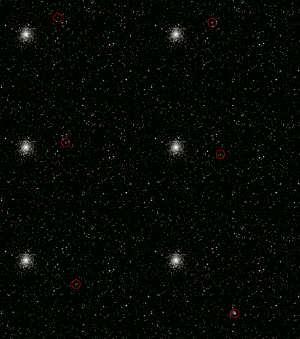 Rosetta s Target Comet
23.05.2014
The Rosetta spacecraft captured this remarkable series of 9 frames between March 27 and May 4, as it closed from 5 million to 2 million kilometers of its target comet. Cruising along...
 Xuyi Station and the Fireball
6.12.2024
Colorful and bright, this streaking fireball meteor was captured in a single exposure taken at Purple Mountain (Tsuchinshan) ObservatoryБs Xuyi Station in 2020, during planet Earth's annual Perseid meteor shower. The dome in the foreground houses the China Near Earth Object Survey Telescope (CNEOST), the largest multi-purpose Schmidt telescope in China.
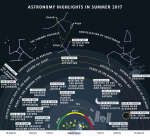 Highlights of the Summer Sky
5.06.2017
What's up in the sky this summer? The featured graphic gives a few highlights for Earth's northern hemisphere. Viewed as a clock face centered at the bottom, early summer sky events fan out toward the left, while late summer events are projected toward the right.
 Perseid Night at Yosemite
18.08.2016
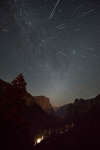
The 2016 Perseid meteor shower performed well on the night of August 11/12. The sky on that memorable evening was recorded from a perch overlooking Yosemite Valley, planet Earth, in this scene composed of 25 separate images selected from an all-night set of sequential exposures.
 When Gemini Sends Stars to Paranal
13.12.2015
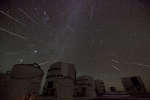
From a radiant point in the constellation of the Twins, the annual Geminid meteor shower rain down on planet Earth. Tonight, the Geminds reach their peak and could be quite spectacular. The featured blended image, however, captured the shower's impressive peak in the year 2012.
 The Comet and the Fireball
20.12.2021
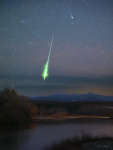
This picture was supposed to feature a comet. Specifically, a series of images of the brightest comet of 2021 were being captured: Comet Leonard. But the universe had other plans. Within a fraction of a second, a meteor so bright it could be called a fireball streaked through just below the comet.
 Moon Struck
8.12.2001
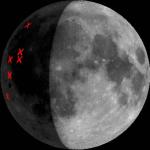
Craters produced by ancient impacts on the airless Moon have long been a familiar sight. But only since 1999 have observers seen elusive optical flashes on the lunar surface - likely explosions resulting from impacting meteoroids. These startling observations were made with modest telescopes and video equipment during the 1999 and 2001 Leonid meteor showers.
 Fireball!
26.02.1996
On rare but spectacular occasions, fireballs, meteors brighter than the brightest stars, flash through the heavens - sometimes making audible sounds and occasionally surviving to strike the Earth's surface. The path of one such...
|
January February March April May June July August September October |
|||||||||||||||||||||||||||||||||||||||||||||||||