
|
You entered: molecular cloud
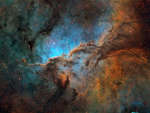 Shaping NGC 6188
16.07.2010
Dark shapes with bright edges winging their way through dusty NGC 6188 are tens of light-years long. The emission nebula is found near the edge of an otherwise dark large molecular cloud in the southern constellation Ara, about 4,000 light-years away.
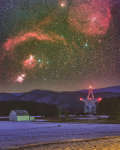 Orion over Green Bank
23.02.2022
What will the huge Green Bank Telescope discover tonight? Pictured, the Robert C. Byrd Green Bank Telescope (GBT) on the lower right is the largest fully-pointable single-dish radio telescope in the world. With...
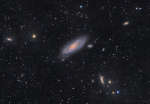 The View Toward M106
16.01.2016
A big, bright, beautiful spiral, Messier 106 is at the center of this galaxy filled cosmic vista. The two degree wide telescopic field of view looks toward the well-trained constellation Canes Venatici, near the handle of the Big Dipper.
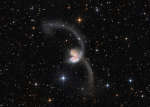 Exploring the Antennae
31.03.2022
Some 60 million light-years away in the southerly constellation Corvus, two large galaxies are colliding. Stars in the two galaxies, cataloged as NGC 4038 and NGC 4039, very rarely collide in the course of the ponderous cataclysm that lasts for hundreds of millions of years.
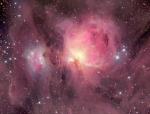 M42: Wisps of the Orion Nebula
25.02.2003
The Great Nebula in Orion, an immense, nearby starbirth region, is probably the most famous of all astronomical nebulas. Here, glowing gas surrounds hot young stars at the edge of an immense interstellar molecular cloud only 1500 light-years away. In the above deep image, faint wisps and sheets of dust and gas are particularly evident.
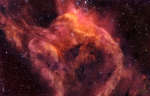 NGC 3572 and the Southern Tadpoles
6.05.2022
This cosmic skyscape features glowing gas and dark dust clouds along side the young stars of NGC 3572. A beautiful emission nebula and star cluster it sails far southern skies within the nautical constellation Carina.
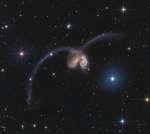 Exploring the Antennae
28.04.2017
Some 60 million light-years away in the southerly constellation Corvus, two large galaxies are colliding. Stars in the two galaxies, cataloged as NGC 4038 and NGC 4039, very rarely collide in the course of the ponderous cataclysm that lasts for hundreds of millions of years.
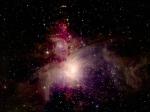 Orion Nebula: The 2MASS View
20.04.2002
Few astronomical sights excite the imagination like the nearby stellar nursery known as the Orion Nebula. The Nebula's glowing gas surrounds hot young stars at the edge of an immense interstellar molecular cloud only 1,500 light-years away.
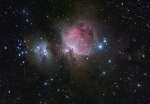 Classic Orion Nebulae
26.08.2009
The Great Nebula in Orion, also known as M42, is one of the most famous nebulae in the sky. The star forming region's glowing gas clouds and hot young stars are near...
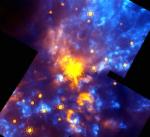 The Heart Of Orion
23.05.1997
Newborn stars lie at the heart of the Orion Nebula, hidden from view by the dust and gas of the giant Orion Molecular Cloud number 1 (OMC-1). Sensitive to invisible infrared wavelengths, Hubble...
|
January February March April May June July August September October |
|||||||||||||||||||||||||||||||||||||||||||||||||