
|
You entered: stars
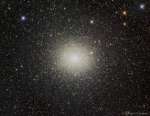 Omega Centauri: The Brightest Globular Star Cluster
27.04.2016
This huge ball of stars predates our Sun. Long before humankind evolved, before dinosaurs roamed, and even before our Earth existed, ancient globs of stars condensed and orbited a young Milky Way Galaxy. Of the 200 or so globular clusters that survive today, Omega Centauri is the largest, containing over ten million stars.
 APOD: 2025 February 25 Б M41: The Little Beehive Star Cluster
25.02.2025
Why are there so many bright blue stars? Stars are usually born in clusters, and the brightest and most massive of these stars typically glow blue. Less-bright, non-blue stars like our Sun surely also exist in this M41 star cluster but are harder to see. A few bright orange-appearing red giant stars are visible.
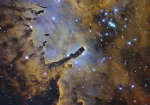 NGC 6823: Cloud Sculpting Star Cluster
8.10.2014
Star cluster NGC 6823 is slowly turning gas clouds into stars. The center of the open cluster, visible on the upper right, formed only about two million years ago and is dominated in brightness by a host of bright young blue stars.
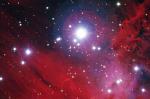 NGC 2264: Stars, Dust, and Gas
24.04.2001
The nebula surrounding bright star S Mon is filled with dark dust and glowing gas. The strange shapes that haunt this star forming region originate from fine interstellar dust reacting in complex ways to the energetic light and hot gas being expelled by the young stars.
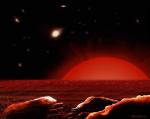 Stars Without Galaxies
15.02.1998
Galaxies are made up of stars, but are all stars found within galaxies? Using the Hubble Space Telescope, researchers exploring the Virgo Cluster of galaxies have now found about 600 red giant stars adrift in intergalactic space. Above is an artist's vision of the sky from a hypothetical planet of such a lonely sun.
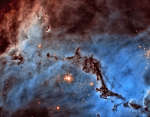 N11: Star Clouds of the LMC
11.02.2013
Massive stars, abrasive winds, mountains of dust, and energetic light sculpt one of the largest and most picturesque regions of star formation in the Local Group of Galaxies. Known as N11, the region...
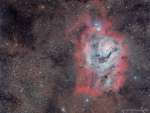 The Lagoon Nebula in Stars Dust and Gas
24.09.2014
The large majestic Lagoon Nebula is home for many young stars and hot gas. Spanning 100 light years across while lying only about 5000 light years distant, the Lagoon Nebula is so big and bright that it can be seen without a telescope toward the constellation of Sagittarius.
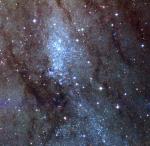 Stars of NGC 206
2.04.1999
Nestled within the dusty arms of the large spiral galaxy Andromeda (M31), the star cluster NGC 206 is one of the largest star forming regions known in our local group of galaxies. The beautiful...
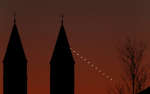 The Last Days of Venus as the Evening Star
6.01.2022
That's not a young crescent Moon posing behind cathedral towers after sunset. It's Venus in a crescent phase. About 40 million kilometers away and about 2 percent illuminated by sunlight...
 Messier 24: Sagittarius Star Cloud
29.06.2018
Unlike most entries in Charles Messier's famous catalog of deep sky objects, M24 is not a bright galaxy, star cluster, or nebula. It's a gap in nearby, obscuring intertellar dust clouds that allows a view of the distant stars in the Sagittarius spiral arm of our Milky Way galaxy.
|
January February March April May June July August September October |
|||||||||||||||||||||||||||||||||||||||||||||||||