
|
You entered: NASA
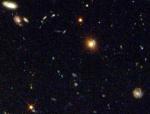 The Hubble Deep Field South
14.12.1998
Among the faintest objects are some of the most unusual objects. The Hubble Deep Field South was released after much anticipation earlier this month, delivering a unique view of some of the most distant parts of our universe. Part of this field is shown above.
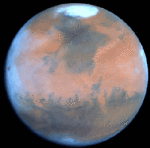 A Halloween Invasion from Mars
31.10.1995
Orson Welles became an instant legend on Halloween in 1938 for his radio dramatization of H.G. Wells' "War of the Worlds". Some listeners who did not realize it was a theatrical production were driven to near panic by this fictional account of invaders from Mars.
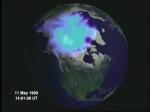 Unusual Aurora During Solar Wind Dropout
23.12.1999
On May 10, for some unknown reason, the Solar Wind virtually stopped. Normally our Sun emits a wind of between five and ten energetic particles per cubic centimeter moving outward at about 500 kilometers per second.
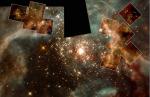 Massive Stars Of 30 Doradus
30.09.1999
This gorgeous visible-light Hubble Space Telescope image shows a young cluster of massive stars at the center of the 30 Doradus Nebula. Gas and dust clouds in 30 Doradus, also known as the Tarantula Nebula, have been sculpted into elongated shapes by powerful winds and ultraviolet radiation from these hot cluster stars.
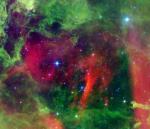 Hot Stars in the Rosette Nebula
26.07.2007
Winds and radiation from massive hot stars in the Rosette Nebula have cleared the natal gas and dust from the center of the nearby star-forming region. They also pose a danger to planet forming disks around young, cooler stars in the neighborhood.
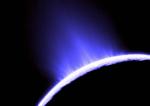 Enceladus Ice Geysers
13.10.2007
Ice geysers erupt on Enceladus, bright and shiny inner moon of Saturn. Shown in this false-color image, a backlit view of the moon's southern limb, the majestic, icy plumes were discovered by instruments on the Cassini Spacecraft during close encounters with Enceladus in November of 2005.
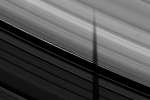 Jagged Shadows May Indicate Saturn Ring Particles
15.04.2009
What's causing unusual jagged shadows on Saturn's rings? No one is yet sure. As Saturn nears equinox, its rings increasingly show only their thin edge to the Earth and Sun. As a result, Saturn's moons now commonly cast long shadows onto the rings.
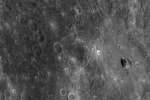 Unknown Dark Material on Mercury
6.07.2009
What is that strange material on Mercury? When flying by Mercury last October, the robotic MESSENGER spacecraft imaged much of the solar system's innermost planet in unprecedented detail. As common in science, new data bring new mysteries.
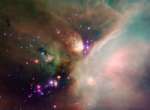 Young Stars in the Rho Ophiuchi Cloud
13.11.2009
Cosmic dust clouds and embedded newborn stars glow at infrared wavelengths in this tantalizing false-color view from the Spitzer Space Telescope. Pictured is of one of the closest star forming regions, part of the Rho Ophiuchi cloud complex some 400 light-years distant near the southern edge of the pronounceable constellation Ophiuchus.
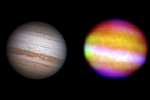 Jupiter from the Stratosphere
3.06.2010
SOFIA, the Stratospheric Observatory for Infrared Astronomy, captured its "first light" images on May 26, from an altitude of 35,000 feet. While flying above most of planet Earth's infrared-absorbing water vapor, SOFIA's premier infrared views of the cosmos included this remarkable false-color image (right panel) of Jupiter.
|
January February March April May June July August September October |
|||||||||||||||||||||||||||||||||||||||||||||||||