
|
You entered: light
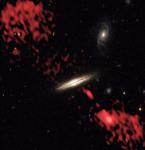 192: The Wrong Galaxy
14.01.2003
Centered above is distant galaxy 0313-192, some one billion light-years away. Radio emission from the galaxy has been mapped by the National Radio Astronomy Observatory's Very Large Array and is shown in red, composited with a visible light image from the Hubble Space Telescope's new Advanced Camera for Surveys.
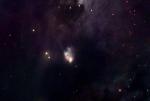 McNeil s Nebula
19.02.2004
It was a clear, cold western Kentucky night on January 23rd as seasoned amateur astronomer Jay McNeil tried out his recently acquired 3-inch refracting telescope by imaging the area around a familiar object, the M78 reflection nebula in Orion.
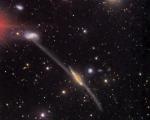 Peculiar Arp 295
8.10.2005
A spectacular bridge of stars and gas stretches for nearly 250,000 light-years and joins this famous peculiar pair of galaxies cataloged as Arp 295. The cosmic bridge between the galaxies and the long...
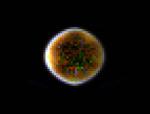 Gamma Ray Earth
3.06.2006
The pixelated planet above is actually our own planet Earth seen in gamma rays - the most energetic form of light. In fact, the gamma rays used to construct this view pack over 35 million electron volts (MeV) compared to a mere two electron volts (eV) for a typical visible light photon.
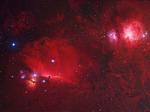 An Orion Deep Field
15.10.2006
Adrift 1,500 light-years away in one of the night sky's most recognizable constellations, the glowing Orion Nebula and the dark Horsehead Nebula are contrasting cosmic vistas. They both appear in this stunning composite digital image assembled from over 20 hours of data that includes exposures filtered to record emission from hydrogen atoms.
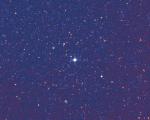 A Close Encounter Of The Stellar Kind
11.12.1999
The unassuming star centered in this sky view will one day be our next door stellar neighbor. The faint 9th magnitude red dwarf, currently 63 light-years away in the constellation Ophiucus, was recently discovered to be approaching our Solar System.
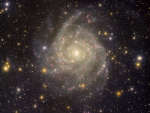 Hidden Galaxy IC 342 from Kitt Peak
9.01.2008
Beautiful nearby spiral galaxy IC 342 could be more famous if it wasn't so hidden. A sprawling island universe, IC 342 would be a prominent galaxy in our night sky, but it is almost hidden from view behind the veil of stars, gas and dust clouds in the plane of our Milky Way galaxy.
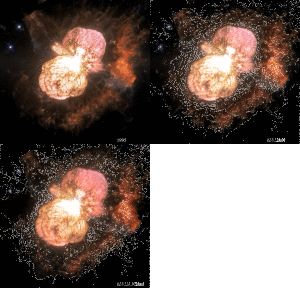 Eta Carinae and the Expanding Homunculus Nebula
1.12.2014
How did the Eta Carinae star system create this unusual expanding nebula? No one knows for sure. About 170 years ago, the southern star system Eta Carinae (Eta Car) mysteriously became the second brightest star system in the night sky. Twenty years later, after ejecting more mass than our Sun, Eta Car unexpectedly faded.
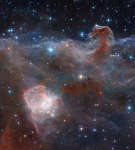 Horsehead: A Wider View
9.03.2018
Combined image data from the massive, ground-based VISTA telescope and the Hubble Space Telescope was used to create this wide perspective of the interstellar landscape surrounding the famous Horsehead Nebula. Captured at near-infrared wavelengths...
 NGC 2419: Intergalactic Wanderer
13.04.2023
Stars of the globular cluster NGC 2419 are packed into this Hubble Space Telescope field of view toward the mostly stealthy constellation Lynx. The two brighter spiky stars near the edge of the frame are within our own galaxy. NGC 2419 itself is remote though, some 300,000 light-years away.
|
January February March April May June July August September October |
|||||||||||||||||||||||||||||||||||||||||||||||||