
|
You entered: Saturn rings
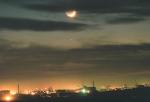 Moon Over Mongolia
16.09.1997
Fighting clouds and the glow of city lights, a young Moon shines over the western horizon of Mongolia's capital Ulaan-Baatar. The thin sunlit crescent is 1.5 days old and strongly over exposed in this image taken on March 10.
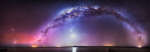 From the Northern to the Southern Cross
27.01.2019
There is a road that connects the Northern to the Southern Cross but you have to be at the right place and time to see it. The road, as pictured here, is actually...
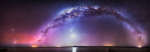 From the Northern to the Southern Cross
27.01.2014
There is a road that connects the Northern to the Southern Cross but you have to be at the right place and time to see it. The road, as pictured above, is actually...
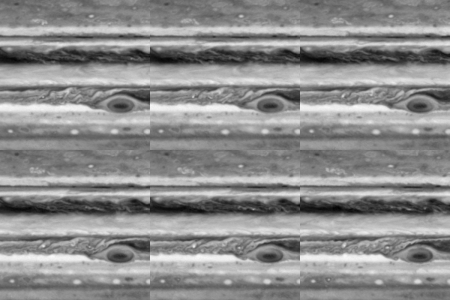 Cassini At Jupiter: Red Spot Movie
23.11.2000
Everything is big on Jupiter, the solar system's reigning gas giant. For example, Jupiter's Great Red Spot is a hurricane-like storm system at least twice the diameter of planet Earth. Approaching Jupiter...
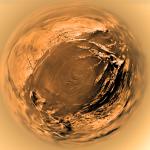 Descent Panorama of Saturns Titan
8.05.2006
You're the first spacecraft ever to descend to Titan -- what do you see? Immediately after the Huygen's probe pierced the cloud deck of Saturn's moon Titan last January, it took a unique series of pictures of one of the Solar System's most mysterious moon's.
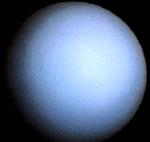 Uranus: The Tilted Planet
15.11.1997
Uranus is the third largest planet after Jupiter and Saturn. This picture was snapped by the Voyager 2 spacecraft in 1986 - the only spacecraft ever to visit Uranus. Uranus has many moons and a ring system. Uranus is composed mostly of rock and ices, but with a thick hydrogen and helium atmosphere.
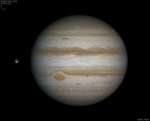 Jupiter, Ganymede, Great Red Spot
15.05.2015
In this sharp snapshot, the Solar System's largest moon Ganymede poses next to Jupiter, the largest planet. Captured on March 10 with a small telescope from our fair planet Earth, the scene also includes Jupiter's Great Red Spot, the Solar System's largest storm.
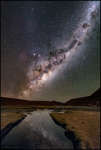 The Altiplano Night
7.07.2016
The Milky Way is massively bright on this cold, clear, altiplano night. At 4,500 meters its reflection in a river, a volcanic peak on the distant horizon, is captured in this stitched panorama under naturally dark skies of the northern Chilean highlands near San Pedro de Atacama.
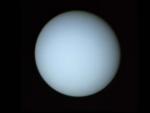 Uranus: The Tilted Planet
26.08.2001
Uranus is the third largest planet in our Solar System after Jupiter and Saturn. Uranus is composed mostly of rock and ices, but with a thick hydrogen and helium atmosphere. The blue hue of Uranus' atmosphere arises from the small amount of methane which preferentially absorbs red light.
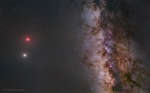 Moon, Mars, and Milky Way
11.08.2018
Just two weeks ago, dark skies over the desert in northern Iran held this alluring celestial vista. The dramatic digital mosaic finds the Moon and Mars alongside the Milky Way's dusty rifts, stars, and nebulae.
|
January February March April May June July August September October |
|||||||||||||||||||||||||||||||||||||||||||||||||