
|
You entered: group of galaxies
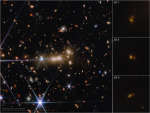 APOD: 2023 January 18 Б MACS0647: Gravitational Lensing of the Early Universe by Webb
18.01.2023
Gravitational lensing by the galaxy cluster MACS0647 -- in which the massive foreground cluster distorts and lenses the light emitted by distant background galaxies along the line of sight Б is on vivid display here in this recent multi-color infrared image from the James Webb Space Telescope (JWST).
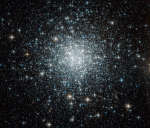 Globular Star Cluster NGC 6934
9.10.2010
Globlular star clusters roam the halo of our Milky Way Galaxy. Gravitationally bound, these spherical groupings of typically several hundred thousand stars are ancient, older than the stars of the galactic disk. In fact...
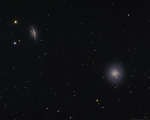 Cetus Galaxies and Supernova
6.12.2018
Large spiral galaxy NGC 1055 at top left joins spiral Messier 77 (bottom right) in this cosmic view toward the aquatic constellation Cetus. The narrowed, dusty appearance of edge-on spiral NGC 1055 contrasts nicely with the face-on view of M77's bright nucleus and spiral arms.
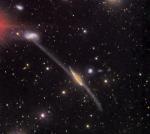 Peculiar Arp 295
10.10.2003
A spectacular bridge of stars and gas stretches for nearly 250,000 light-years and joins this famous peculiar pair of galaxies cataloged as Arp 295. The cosmic bridge between the galaxies and the long...
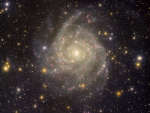 Hidden Galaxy IC 342 from Kitt Peak
9.01.2008
Beautiful nearby spiral galaxy IC 342 could be more famous if it wasn't so hidden. A sprawling island universe, IC 342 would be a prominent galaxy in our night sky, but it is almost hidden from view behind the veil of stars, gas and dust clouds in the plane of our Milky Way galaxy.
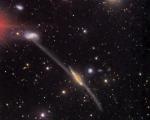 Peculiar Arp 295
8.10.2005
A spectacular bridge of stars and gas stretches for nearly 250,000 light-years and joins this famous peculiar pair of galaxies cataloged as Arp 295. The cosmic bridge between the galaxies and the long...
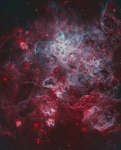 The Tarantula Zone
13.11.2020
The Tarantula Nebula, also known as 30 Doradus, is more than a thousand light-years in diameter, a giant star forming region within nearby satellite galaxy the Large Magellanic Cloud. About 180 thousand light-years away, it's the largest, most violent star forming region known in the whole Local Group of galaxies.
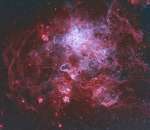 The Tarantula Nebula
16.11.2017
The Tarantula Nebula is more than a thousand light-years in diameter, a giant star forming region within nearby satellite galaxy the Large Magellanic Cloud, about 180 thousand light-years away. The largest, most violent star...
 The Leo Trio
21.03.2024
This popular group leaps into the early evening sky around the March equinox and the northern hemisphere spring. Famous as the Leo Triplet, the three magnificent galaxies found in the prominent constellation Leo gather here in one astronomical field of view.
 The Tarantula Nebula
26.02.2016
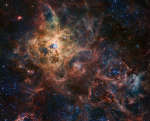
The Tarantula Nebula is more than a thousand light-years in diameter, a giant star forming region within nearby satellite galaxy the Large Magellanic Cloud, about 180 thousand light-years away. The largest, most violent star...
|
January February March April May June July August September October |
|||||||||||||||||||||||||||||||||||||||||||||||||