
|
You entered: hot star
 Runaway Star Alpha Camelopardalis
28.04.2023
Like a ship plowing through cosmic seas, runaway star Alpha Camelopardalis has produced this graceful arcing bow wave or bow shock. The massive supergiant star moves at over 60 kilometers per second through space, compressing the interstellar material in its path.
 APOD: 2023 August 28 Б Star Formation in the Pacman Nebula
28.08.2023
Look through the cosmic cloud cataloged as NGC 281 and you might miss the stars of open cluster IC 1590. Formed within the nebula, that cluster's young, massive stars ultimately power the pervasive nebular glow.
 Portrait of NGC 281
27.11.2014
Look through the cosmic cloud cataloged as NGC 281 and you might miss the stars of open cluster IC 1590. But, formed within the nebula, that cluster's young, massive stars ultimately power the pervasive nebular glow.
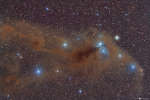 Stars and Dust Across Corona Australis
27.06.2011
Cosmic dust clouds sprawl across a rich field of stars in this sweeping telescopic vista near the northern boundary of Corona Australis, the Southern Crown. Probably less than 500 light-years away and effectively blocking...
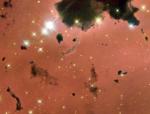 Thackerays Globules
16.08.2003
Rich star fields and glowing hydrogen gas silhouette dense, opaque clouds of interstellar gas and dust in this Hubble Space Telescope close-up of IC 2944, a bright star forming region in Centaurus, 5,900 light-years away. The largest of these dark globules, first spotted by South African astronomer A. D.
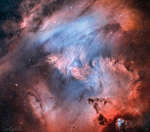 Wide Field: Fox Fur, Unicorn, and Christmas Tree
10.03.2020
What do the following things have in common: a cone, the fur of a fox, and a Christmas tree? Answer: they all occur in the constellation of the unicorn (Monoceros). Pictured as a star...
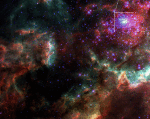 In the Center of 30 Doradus
21.02.1999
In the center of 30 Doradus lies a huge cluster of the largest, hottest, most massive stars known. The center of this cluster, known as R136, is boxed in the upper right portion of the above picture.
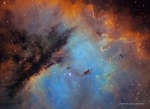 Portrait of NGC 281
30.09.2017
Look through the cosmic cloud cataloged as NGC 281 and you might miss the stars of open cluster IC 1590. Still, formed within the nebula that cluster's young, massive stars ultimately power the pervasive nebular glow.
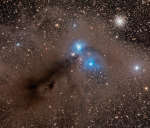 Stars and Dust Across Corona Australis
27.09.2012
Cosmic dust clouds sprawl across a rich field of stars in this sweeping telescopic vista near the northern boundary of Corona Australis, the Southern Crown. Probably less than 500 light-years away and effectively blocking...
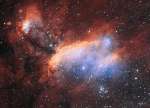 IC 4628: The Prawn Nebula
23.09.2013
South of Antares, in the tail of the nebula-rich constellation Scorpius, lies emission nebula IC 4628. Nearby hot, massive stars, millions of years young, radiate the nebula with invisible ultraviolet light, stripping electrons from atoms. The electrons eventually recombine with the atoms to produce the visible nebular glow, dominated by the red emission of hydrogen.
|
January February March April May June July |
|||||||||||||||||||||||||||||||||||||||||||||||||