
|
You entered: open cluster
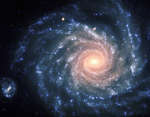 Grand Spiral Galaxy NGC 1232
7.01.2012
Galaxies are fascinating not only for what is visible, but for what is invisible. Grand spiral galaxy NGC 1232, captured in detail by one of the new Very Large Telescopes, is a good example.
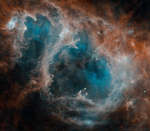 The Soul Nebula in Infrared from Herschel
4.10.2017
Stars are forming in the Soul of the Queen of Aethopia. More specifically, a large star forming region called the Soul Nebula can be found in the direction of the constellation Cassiopeia, who Greek mythology credits as the vain wife of a King who long ago ruled lands surrounding the upper Nile river.
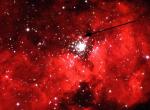 Sher 25: A Pending Supernova?
12.08.1997
No supernova has ever been predicted - yet. These dramatic stellar explosions that destroy stars, that create and disperse the elements that compose people and planets, that light up the night sky, are not so well understood that astronomers can accurately predict when a star will explode - yet. Perhaps Sher 25 will be the first.
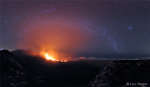 The Milky Way Over the Peak of the Furnace
1.11.2010
On Reunion Island, it is known simply as "The Volcano." To others, it is known as the Piton de la Fournaise, which is French for the Peak of the Furnace. It is one of the most active volcanoes in the world.
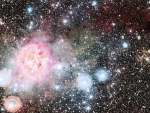 The Cocoon Nebula from CFHT
14.01.2008
What creates the colors of the Cocoon Nebula? The Cocoon Nebula, cataloged as IC 5146, is a strikingly beautiful nebula located about 4,000 light years away toward the constellation of the Swan (Cygnus). Inside the Cocoon Nebula is a newly developing open cluster of stars.
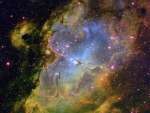 Inside the Eagle Nebula
8.02.2009
From afar, the whole thing looks like an Eagle. A closer look at the Eagle Nebula, however, shows the bright region is actually a window into the center of a larger dark shell of dust. Through this window, a brightly-lit workshop appears where a whole open cluster of stars is being formed.
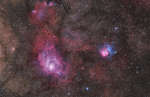 A Sagittarius Triplet
1.06.2012
These three bright nebulae are often featured in telescopic tours of the constellation Sagittarius and the crowded starfields of the central Milky Way. In fact, 18th century cosmic tourist Charles Messier cataloged two of them; M8, the large nebula left of center, and colorful M20 on the right.
 APOD: 2023 May 15 Б M16: Eagle Nebula Deep Field
15.05.2023
From afar, the whole thing looks like an eagle. A closer look at the Eagle Nebula, however, shows the bright region is actually a window into the center of a larger dark shell of dust. Through this window, a brightly-lit workshop appears where a whole open cluster of stars is being formed.
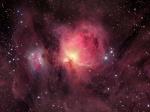 M42: Wisps of the Orion Nebula
18.09.2005
The Great Nebula in Orion, an immense, nearby starbirth region, is probably the most famous of all astronomical nebulas. Here, glowing gas surrounds hot young stars at the edge of an immense interstellar molecular cloud only 1500 light-years away. In the above deep image, faint wisps and sheets of dust and gas are particularly evident.
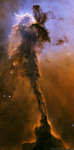 The Fairy of Eagle Nebula
2.12.2018
The dust sculptures of the Eagle Nebula are evaporating. As powerful starlight whittles away these cool cosmic mountains, the statuesque pillars that remain might be imagined as mythical beasts. Featured here is one of several striking dust pillars of the Eagle Nebula that might be described as a gigantic alien fairy.
|
January February March April May June July August September October |
|||||||||||||||||||||||||||||||||||||||||||||||||