
|
You entered: ring galaxy
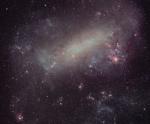 The Large Cloud of Magellan
2.09.2004
Portuguese navigator Fernando de Magellan and his crew had plenty of time to study the southern sky during the first circumnavigation of planet Earth. As a result, two fuzzy cloud-like objects easily visible for southern hemisphere skygazers are known as the Clouds of Magellan.
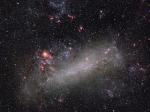 The Large Cloud of Magellan
10.05.2006
Portuguese navigator Fernando de Magellan and his crew had plenty of time to study the southern sky during the first circumnavigation of planet Earth. As a result, two fuzzy cloud-like objects easily visible for southern hemisphere skygazers are known as the Clouds of Magellan.
 APOD: 2025 May 12 Б Gaia Reconstructs a Side View of our Galaxy
12.05.2025
What does our Milky Way Galaxy look like from the side? Because we are on the inside, humanity canБt get an actual picture. Recently, however, just such a map has been made using location data for over a billion stars from ESAБs Gaia mission.
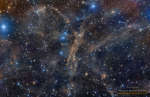 A Dust Angel Nebula
28.04.2016
The combined light of stars along the Milky Way are reflected by these cosmic dust clouds that soar some 300 light-years or so above the plane of our galaxy. Dubbed the Angel Nebula, the faint apparition is part of an expansive complex of dim and relatively unexplored, diffuse molecular clouds.
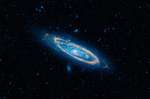 WISE Infrared Andromeda
19.02.2010
This sharp, wide-field view features infrared light from the spiral Andromeda Galaxy (M31). Dust heated by Andromeda's young stars is shown in yellow and red, while its older population of stars appears as a bluish haze. The false-color skyscape is a mosaic of images from NASA's new Wide-field Infrared Survey Explorer (WISE) satellite.
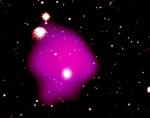 Hot Gas and Dark Matter
4.04.1999
Is the gravity of the galaxies seen in this image high enough to contain the glowing hot gas? Superposed on an optical picture of a group of galaxies is an image taken in X-ray light.
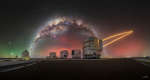 APOD: 2026 March 10 Б Sky Glows over Paranal Observatory
10.03.2026
Are lasers from giant telescopes being used to defend the Earth? No. Lasers shot from telescopes are now commonly used to help increase the accuracy of astronomical observations. In some directions, Earth atmosphere-induced fluctuations in starlight can indicate how the air mass over a telescope is changing, but in other directions, no bright star exists.
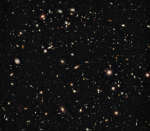 HUDF Infrared: Dawn of the Galaxies
9.12.2009
When did galaxies form? To help find out, the deepest near-infrared image of the sky ever has been taken of the same field as the optical-light Hubble Ultra Deep Field (HUDF) in 2004. The new image was taken this summer by the newly installed Wide Field Camera 3 on the refurbished Hubble Space Telescope.
 Earendel: A Star in the Early Universe
6.04.2022
Is Earendel the farthest star yet discovered? This scientific possibility started when the Hubble Space Telescope observed a huge cluster of galaxies. The gravitational lens effectбof this cluster was seen to magnify and distort a galaxy far in the background.
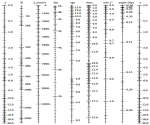 A Redshift Lookup Table for our Universe
8.04.2013
How far away is "redshift six"? Although humans are inherently familiar with distance and time, what is actually measured for astronomical objects is redshift, a color displacement that depends on exactly how energy density has evolved in our universe.
|
January February March April May June July August September October |
|||||||||||||||||||||||||||||||||||||||||||||||||