
|
You entered: stars
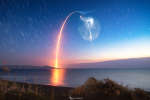 South Celestial Rocket Launch
28.02.2020
At sunset on December 6 a Rocket Lab Electron rocket was launched from a rotating planet. With multiple small satellites on board it departed on a mission to low Earth orbit dubbed Running Out of Fingers from Mahia Peninsula on New Zealand's north island.
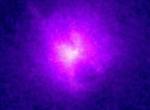 Hot Gas In Hydra A
17.12.1999
The Hydra A galaxy cluster is really big. In fact, such clusters of galaxies are the largest gravitationally bound objects in the Universe. But individual galaxies are too cool to be recorded in this false-color Chandra Observatory X-ray image which shows only the 40 million degree gas that permeates the Hydra A cluster.
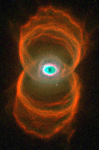 MyCn18: An Hourglass Nebula
18.01.1996
The sands of time are running out for the central star of this hourglass-shaped planetary nebula. With its nuclear fuel exhausted, this brief, spectacular, closing phase of a Sun-like star's life occurs as its outer layers are ejected - its core becoming a cooling, fading White Dwarf.
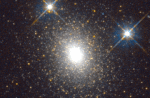 A Giant Globular Cluster in M31
26.04.1996
G1, pictured above, is the brightest known globular cluster in the whole Local Group of galaxies. Also called Mayall II, it orbits the center of the largest nearby galaxy: M31. G1 contains over 300,000 stars and is almost as old as the entire universe.
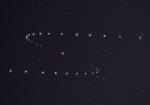 S is for Venus
7.01.2005
Planet Venus traced out this S shape in Earth's sky during 2004. Following the second planet from the Sun in a series of 29 images recorded from April 3rd through August...
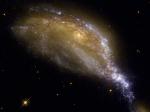 A Galaxy Collision in NGC 6745
5.11.2006
Galaxies don't normally look like this. NGC 6745 actually shows the results of two galaxies that have been colliding for only hundreds of millions of years. Just off the above photograph to the lower right is the smaller galaxy, moving away.
 The Milky Way in Infrared
30.01.2000
At night, from a dark location, part of the clear sky looks milky. This unusual swath of dim light is generally visible during any month and from any location. Until the invention of the telescope, nobody really knew what the "Milky Way" was.
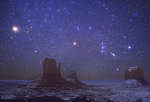 Mars and Orion Over Monument Valley
25.12.2007
Welcome to The World At Night. Sharing the night sky seen around the world, this view from Monument Valley, USA includes a picturesque foreground of famous buttes. Buttes are composed of hard volcanic rock left behind after water eroded away the surrounding soft rock.
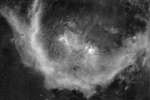 Barnards Loop around the Horsehead Nebula
24.02.2009
Why is the Horsehead Nebula surrounded by a bubble? Although hard to make out above, the famous Horsehead Nebula is the slight dark indentation in the bright streak just to the left of the image center. Glowing like an emission nebula, the origin of the bubble, known as Barnard's Loop, is currently unknown.
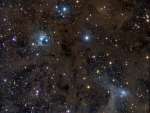 Stardust in Aries
25.11.2010
This composition in stardust covers almost 2 degrees on the sky, close to the border of the zodiacal constellation Aries and the plane of our Milky Way Galaxy. At the lower right...
|
January February March April May June July August September October |
|||||||||||||||||||||||||||||||||||||||||||||||||