
|
You entered: Earth
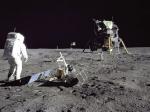 Moonquakes Surprisingly Common
27.03.2006
Why are there so many moonquakes? A recent reanalysis of seismometers left on the moon by the Apollo moon landings has revealed a surprising number of moonquakes occurring within 30 kilometers of the surface. In fact, 28 moonquakes were detected in data recorded between 1972 and 1977.
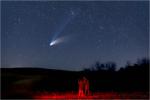 Hale Bopp: The Great Comet of 1997
31.03.2007
Ten short years ago, Comet Hale-Bopp rounded the Sun and offered a dazzling spectacle in planet Earth's night. This stunning view, recorded shortly after the comet's perihelion passage on April 1, 1997, features the memorable tails of Hale-Bopp -- a whitish dust tail and blue ion tail.
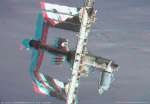 Stereo Space Station
23.02.2008
Get out your red-blue glasses and float next to the International Space Station (ISS), planet Earth's largest artificial moon. This fun stereo view was constructed from parts of two separate images (S122-E-009880, S122-E-009893) and an additional background recorded as the shuttle orbiter Atlantis undocked from the ISS on February 18.
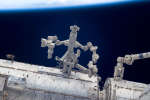 Dextre Robot at Work on the Space Station
11.06.2008
What's the world's most complex space robot doing up there? Last week, Dextre was imaged moving atop the Destiny Laboratory Module of the International Space Station (ISS), completing tasks prior to the deployment of Japan's Kibo pressurized science laboratory.
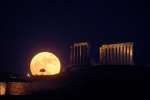 Solstice Moonrise, Cape Sounion
20.06.2008
Today's solstice marks the northernmost point of the Sun's annual motion through planet Earth's sky and the astronomical beginning of the northern hemisphere's summer. But only two days ago, the Full Moon nearest the solstice rose close to the ecliptic plane opposite the Sun, near its southernmost point for the year.
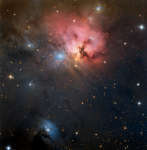 NGC 1579: Trifid of the North
9.03.2012
Colorful NGC 1579 resembles the better known Trifid Nebula, but lies much farther north in planet Earth's sky, in the heroic constellation Perseus. About 2,100 light-years away and 3 light-years across...
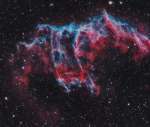 A Spectre in the Eastern Veil
30.10.2013
Frightening forms and scary faces are a mark of the Halloween season. They also haunt this cosmic close-up of the eastern Veil Nebula. The Veil Nebula itself is a large supernova remnant, the expanding debris cloud from the death explosion of a massive star.
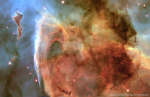 The Keyhole in the Carina Nebula
14.08.2016
The dark dusty Keyhole Nebula gets its name from its unusual shape. The looping Keyhole, in this featured classic image by the Hubble Space Telescope, is a smaller region inside the larger Carina Nebula.
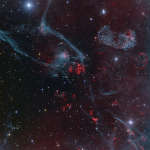 Puppis A Supernova Remnant
29.09.2017
Driven by the explosion of a massive star, supernova remnant Puppis A is blasting into the surrounding interstellar medium about 7,000 light-years away. At that distance, this colorful telescopic field based on broadband and narrowband optical image data is about 60 light-years across.
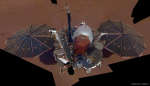 InSight Lander Takes Selfie on Mars
21.01.2019
This is what NASA's Insight lander looks like on Mars. With its solar panels, InSight is about the size of a small bus. Insight successfully landed on Mars in November with a main objective to detect seismic activity.
|
January February March April May June July August September October |
|||||||||||||||||||||||||||||||||||||||||||||||||