
|
You entered: star
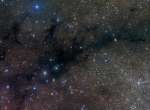 LDN 988 and Friends
23.09.2015
Stars are forming in dark, dusty molecular cloud LDN 988. Seen near picture center some 2,000 light-years distant, LDN 988 and other nearby dark nebulae were cataloged by Beverly T. Lynds in 1962 using Palomar Observatory Sky Survey plates.
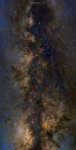 Great Rift Near the Center of the Milky Way
9.11.2016
Over 100 telescopic image panels in this stunning vertical mosaic span about 50 degrees across the night sky. They follow part of the Great Rift, the dark river of dust and molecular gas that stretches along the plane of our Milky Way Galaxy.
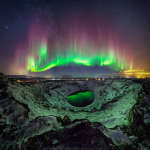 Colorful Aurora over Iceland
5.03.2017
You don't always see a scene this beautiful when you hike to an ancient volcano -- you have to be lucky. When the astrophotographer realized that aurora were visible two-weeks ago, he made a night-time run for the top of the caldera to see if he could capture them also reflected in the central lake.
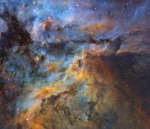 South of Carina
21.05.2020
With natal dust clouds in silhouette against glowing atomic gas, this colorful and chaotic vista lies within one of the largest star forming regions in the Milky Way galaxy, the Great Carina Nebula.
 COMPTEL Explores The Radioactive Sky
24.07.1996
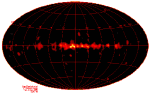
Diffuse gas clouds laced with radioactive aluminum atoms (Al26) line the plane of our Milky Way Galaxy! How do we see them? Relying on the Compton Effect, the COMPTEL instrument onboard NASA's immense orbiting Compton Gamma Ray Observatory can "see" the 1.8 million electron Volt gamma rays emitted by the radioactive decay.
 Hen 1357: New Born Nebula
6.10.2001
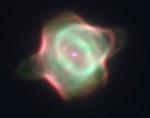
This Hubble Space Telescope snapshot shows Hen-1357, the youngest known planetary nebula. Graceful, gentle curves and symmetry suggest its popular name - The Stingray Nebula. Observations in the 1970s detected no nebular material, but this image from March 1996 clearly shows the Stingray's emerging bubbles and rings of shocked and ionized gas.
 NGC 7293: The Helix Nebula
17.04.1996
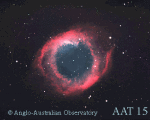
The Helix nebula (New General Catalog number 7293) is estimated to be a mere 450 light-years from the Sun, in the direction of the constellation Aquarius. At that distance it may well be the closest planetary nebula, offering a dramatic snapshot of a brief final evolutionary stage in the life of a solar-type star.
 Orion's Horsehead Nebula
2.10.1996
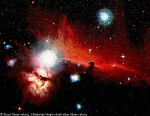
The Horsehead Nebula is arguably the most famous nebula on the sky. It is visible as the black indentation to the red emission nebula seen just to the right of center of the above photograph. The bright star near the center is located in the belt of the familiar constellation of Orion.
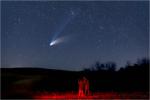 Hale Bopp: The Great Comet of 1997
31.03.2007
Ten short years ago, Comet Hale-Bopp rounded the Sun and offered a dazzling spectacle in planet Earth's night. This stunning view, recorded shortly after the comet's perihelion passage on April 1, 1997, features the memorable tails of Hale-Bopp -- a whitish dust tail and blue ion tail.
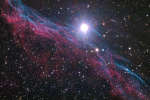 NGC 6960: The Witch s Broom Nebula
19.08.2008
Ten thousand years ago, before the dawn of recorded human history, a new light must suddenly have appeared in the night sky and faded after a few weeks. Today we know this light was an exploding star and record the colorful expanding cloud as the Veil Nebula.
|
January February March April May June July August September October |
|||||||||||||||||||||||||||||||||||||||||||||||||