
|
You entered: Solar System
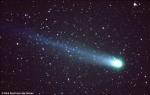 Hyakutake: Stars Through A Comet Tail
17.07.1998
Comets are cosmic icebergs. They follow very elongated orbits which carry them from the frozen, remote outer reaches of the Solar System to close encounters with the Sun. Heated by sunlight, they slough off layers of material as gas and dust, forming their characteristic awe-inspiring comas (heads) and tails.
 Wanderers
7.12.2014
How far out will humanity explore? If this video's fusion of real space imagery and fictional space visualizations is on the right track, then at least the Solar System. Some of the video...
 APOD: 2023 March 26 Б Wanderers
26.03.2023
How far out will humanity explore? If this video's fusion of real space imagery and fictional space visualizations is on the right track, then at least the Solar System. Some of the video...
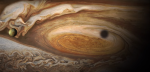 Juno Mission Trailer
28.06.2016
What will NASA's Juno spacecraft find when it reaches Jupiter next Monday? Very little, if Juno does not survive Jupiter Orbit Insertion, a complex series of operations in an unknown environment just above Jupiter's cloud tops.
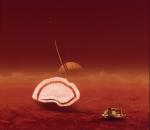 A Portrait of Saturn from Titan
13.10.2001
This artistic portrait of Saturn depicts how it might look from Titan, Saturn's largest moon. In the foreground sits ESA's Huygens probe, which will be released by NASA's Cassini spacecraft and parachute to Titan's surface. Cassini will reach Saturn in 2004 and release the Huygens probe later that year.
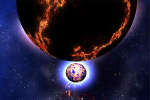 On the Origin of Gold
11.09.2011
Where did the gold in your jewelry originate? No one is completely sure. The relative average abundance in our Solar System appears higher than can be made in the early universe, in stars, and even in typical supernova explosions.
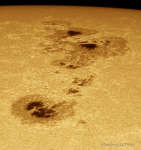 APOD: 2026 June 28 Б AR 4478: Giant Sunspot Group
28.06.2026
Right now, one of the largest sunspot groups in recent history is crossing the Sun. Active Region 4478 is not only big -- it's violent, showing tangled magnetic fields capable of throwing off huge clouds of particles into the Solar System. Some of these CMEs might impact the Earth.
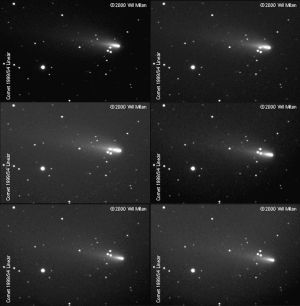 Comet LINEAR Approaches
4.07.2000
Just possibly, a new comet may become bright enough to see without binoculars later this month. Comet C/1999 S4 LINEAR is rapidly approaching both the Earth and the Sun from the outer Solar System, and should be at its brightest around 2000 July 25 in the early evening sky of northern observers.
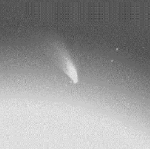 Comet Hyakutake Passes the Sun
16.05.1996
On May 1, Comet Hyakutake made its closest approach to the Sun. During this time it was not possible to view the comet with most astronomical instruments because of the brightness of the nearby Sun.
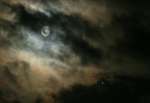 Moons and Jupiter
14.07.2009
Earth's Moon and planet Jupiter made a beautiful pairing in the night sky late last week. This skyscape recorded on July 11 from Brittany in north western France captures the bright conjunction through a cloud bank.
|
January February March April May June July August |
||||||||||||||||||||||||||||||||||||||||||||||||||||||||