
|
You entered: hot star
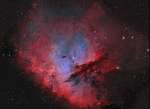 Portrait of NGC 281
25.08.2011
Look through the cosmic cloud cataloged as NGC 281 and it's almost easy to miss stars of open cluster IC 1590. But, formed within the nebula, that cluster's young, massive stars ultimately power the pervasive nebular glow.
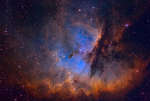 Portrait of NGC 281
4.11.2016
Look through the cosmic cloud cataloged as NGC 281 and you might miss the stars of open cluster IC 1590. Still, formed within the nebula that cluster's young, massive stars ultimately power the pervasive nebular glow.
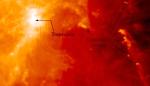 Cometary Globules In Orion
24.09.1999
Intense ultraviolet light from massive, hot stars in the Orion region has sculpted and compressed clouds of dust and gas in to distinctively shaped Cometary Globules. Seen in this IRAS infrared image recorded...
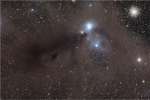 Stars and Dust Across Corona Australis
5.06.2009
Cosmic dust clouds sprawl across a rich field of stars in this sweeping telescopic vista near the northern boundary of Corona Australis, the Southern Crown. Probably less than 500 light-years away and effectively blocking...
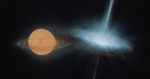 Jets from SS433
13.04.1997
SS433 is one of the most exotic star systems known. Its unremarkable name stems from its inclusion in a catalog of stars which emit radiation characteristic of atomic hydrogen. Its very remarkable behavior stems from a compact object, a black hole or neutron star, which has produced an accretion disk with jets.
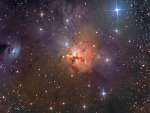 NGC 1579: Trifid of the North
30.01.2009
Colorful NGC 1579 resembles the better known Trifid Nebula, but lies much farther north in planet Earth's sky, in the heroic constellation Perseus. About 2,100 light-years away and 3 light-years across...
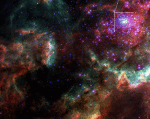 In the Center of 30 Doradus
24.05.1996
In the center of 30 Doradus lies a huge cluster of the largest, hottest, most massive stars known. The center of this cluster, known as R136, is boxed in the upper right portion of the above picture.
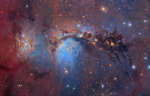 M78: Stardust and Starlight
10.10.2013
Interstellar dust clouds and bright nebulae abound in the fertile constellation of Orion. One of the brightest, M78, is just left of center in this colorful telescopic view, covering an area north of Orion's belt. At a distance of about 1,500 light-years, the bluish nebula itself is about 5 light-years across.
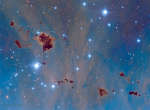 APOD: 2026 May 25 Б Thackerays Globules
25.05.2026
What are these strange space globs? Situated in rich star fields and glowing hydrogen gas, these opaque clouds of interstellar dust and gas are so large they might be able to form stars. Their...
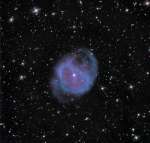 Planetary Nebula Abell 36
30.05.2014
The gorgeous, gaseous shroud of a dying sunlike star, planetary nebula Abell 36 lies a mere 800 light-years away in the constellation of Virgo. At that distance it spans over 1.5 light-years in this sharp telescopic view.
|
January February March April May June July |
|||||||||||||||||||||||||||||||||||||||||||||||||