
|
You entered: image
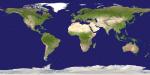 Earth in True Color
5.03.2002
Here are the true colors of planet Earth. Blue oceans dominate our world, while areas of green forest, brown mountains, tan desert, and white ice are also prominent. Oceans appear blue not only because water itself is blue but also because seawater frequently scatters light from a blue sky.
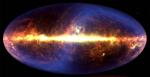 The Infrared Sky
28.01.1998
Three major sources contribute to the far-infrared sky: our Solar System, our Galaxy, and our Universe. The above image, in representative colors, is a projection of the entire infrared sky created from years of observations by the robot spacecraft COBE.
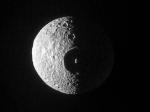 Crater on Mimas
8.03.2005
Whatever hit Mimas nearly destroyed it. What remains is one of the largest impact craters on one of Saturn's smallest moons. The crater, named Herschel after the 1789 discoverer of Mimas, Sir William Herschel, spans about 130 kilometers and is pictured above in the dramatic light of its terminator.
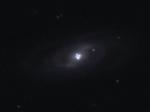 The Einstein Cross Gravitational Lens
11.03.2007
Most galaxies have a single nucleus -- does this galaxy have four? The strange answer leads astronomers to conclude that the nucleus of the surrounding galaxy is not even visible in this image. The central cloverleaf is rather light emitted from a background quasar.
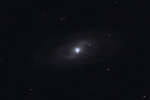 The Einstein Cross Gravitational Lens
7.02.2010
Most galaxies have a single nucleus -- does this galaxy have four? The strange answer leads astronomers to conclude that the nucleus of the surrounding galaxy is not even visible in this image. The central cloverleaf is rather light emitted from a background quasar.
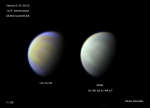 Multicolor Venus
1.03.2012
Brilliant Venus now shines in western skies at twilight. Seen as the prominent evening star, the planet is a tantalizing celestial beacon even for casual skygazers. Venus can offer less than satisfying telescopic views though. The planet is shrouded in reflective clouds that appear bright but featureless at the eyepiece.
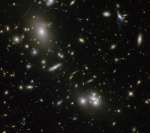 Looking Through Abell 68
8.03.2013
Want to use a cluster of galaxies as a telescope? It's easier than you might think as distant galaxy clusters naturally act as strong gravitional lenses. In accordance with Einstein's theory...
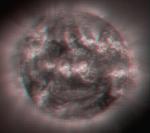 Stereo Sun
7.04.2001
This week's stereo offering features the now famous Active Region 9393, the largest sunspot group in the last 10 years. Viewed with red/blue glasses, the stereo pair of images merges into one 3D representation of the Sun with AR9393 above and right of center.
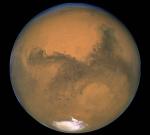 Big Mars from Hubble
27.08.2003
At about 10 am Universal Time today, Mars and Earth will pass closer than in nearly 60,000 years. Mars, noticeably red, will be the brightest object in the eastern sky just after sunset.
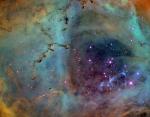 When Roses Aren t Red
24.03.2006
Not all roses are red of course, but they can still be very pretty. Likewise, the beautiful Rosette Nebula and other star forming regions are often shown in astronomical images with a predominately red hue - in part because the dominant emission in the nebula is from hydrogen atoms.
|
January February March April May June July August September |
|||||||||||||||||||||||||||||||||||||||||||||||||