
|
You entered: nearby stars
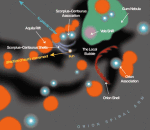 The Local Bubble and the Galactic Neighborhood
17.02.2002
What surrounds the Sun in this neck of the Milky Way Galaxy? Our current best guess is depicted in the above map of the surrounding 1500 light years constructed from various observations and deductions.
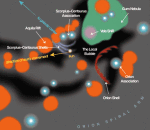 The Local Bubble and the Galactic Neighborhood
12.04.2000
What surrounds the Sun in this neck of the Milky Way Galaxy? Our current best guess is depicted in the above map of the surrounding 1500 light years constructed from various observations and deductions.
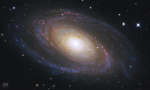 Messier 81
27.03.2025
One of the brightest galaxies in planet Earth's sky is similar in size to our Milky Way Galaxy: big, beautiful Messier 81. Also known as NGC 3031 or Bode's galaxy for its 18th century discoverer, this grand spiral can be found toward the northern constellation of Ursa Major, the Great Bear.
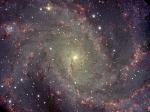 NGC 6946: The Fireworks Galaxy
25.01.2005
Why is this galaxy so active? Nearby spiral galaxy NGC 6946 is undergoing a tremendous burst of star formation with no obvious cause. In many cases spirals light up when interacting with another galaxy, but NGC 6946 appears relatively isolated in space.
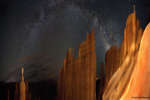 The Milky Way Over Bryce Canyon
27.07.2010
What are those strange rock structures? They are towers and walls of sedimentary rock that are particularly plentiful in Bryce Canyon in Utah, USA. The rock columns may rise higher than 50 meters and are called hoodoos. On the far left is Thor's Hammer, perhaps the most famous hoodoo.
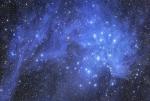 Pleiades and Stardust
22.11.2007
Hurtling through a cosmic dust cloud a mere 400 light-years away, the lovely Pleiades or Seven Sisters star cluster is well-known for its striking blue reflection nebulae. This remarkable wide-field (3 degree) image...
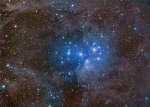 Pleiades and Stardust
14.10.2009
Have you ever seen the Pleiades star cluster? Perhaps the most famous star cluster on the sky, the Pleiades can be seen without binoculars from even the depths of a light-polluted city. Also known as the Seven Sisters and M45, the Pleiades is one of the brightest and closest open clusters.
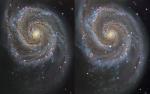 A Nearby Supernova in M51
19.07.2005
One of the nearest supernovas of recent years was discovered late last month in the bright nearby galaxy M51. It is visible on the right of the above before and after images of the picturesque spiral. Can you spot it?
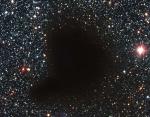 Molecular Cloud Barnard 68
23.09.2001
Where did all the stars go? What used to be considered a hole in the sky is now known to astronomers as a dark molecular cloud. Here, a high concentration of dust and molecular gas absorb practically all the visible light emitted from background stars.
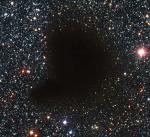 Molecular Cloud Barnard 68
11.05.1999
Where did all the stars go? What used to be considered a hole in the sky is now known to astronomers as a dark molecular cloud. Here, a high concentration of dust and molecular gas absorb practically all the visible light emitted from background stars.
|
January February March April May June July August |
||||||||||||||||||||||||||||||||||||||||||||||||||||||||