
|
You entered: red giant
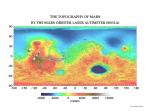 The Topography of Mars
28.06.2001
Mars has its ups and downs. Visible on the above interactive topographic map of the surface of Mars are giant volcanoes, deep valleys, impact craters, and terrain considered unusual and even mysterious. Particularly notable...
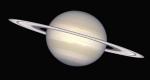 Natural Saturn On The Cassini Cruise
29.01.2000
What could you see approaching Saturn aboard an interplanetary cruise ship? Your view would likely resemble this subtly shaded image of the gorgeous ringed gas giant. Processed by the Hubble Heritage project, the picture...
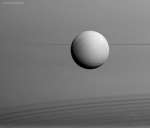 Dione, Rings, Shadows, Saturn
24.08.2015
What's happening in this strange juxtaposition of moon and planet? First and foremost, Saturn's moon Dione was captured here in a dramatic panorama by the robotic Cassini spacecraft currently orbiting the giant planet. The bright and cratered moon itself spans about 1100-km, with the large multi-ringed crater Evander visible on the lower right.
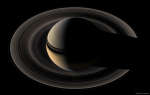 Crescent Saturn
8.08.2020
From Earth, Saturn never shows a crescent phase. But when viewed from a spacecraft the majestic giant planet can show just a sunlit slice. This image of crescent Saturn in natural color was taken by the robotic Cassini spacecraft in 2007.
 A Sky Portal in New Zealand
29.07.2014
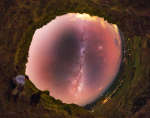
To some, it may look like a portal into the distant universe. To others, it may appear as the eye of a giant. Given poetic license, both are correct. Pictured above is a standard fisheye view of the sky -- but with an unusual projection.
 The Weather on Neptune
28.10.1996
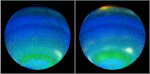
Today's weather on Neptune will be typical. Highs in the upper atmosphere will be about -150 Centigrade, with winds ranging about 900 miles per hour near the equator. Much was learned recently about Neptune's weather by the release last week of time-lapse pictures of the most distant gas giant in our Solar System.
 WIRO at Jupiter
13.03.2003
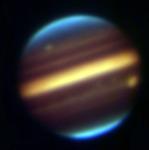
Gazing out over the mountaintops from the Wyoming InfraRed Observatory (WIRO), astronomers recently recorded this bizarre looking image of the solar system's ruling planet, gas giant Jupiter. The false-color picture is a composite...
 M81: A Bulging Spiral Galaxy
13.07.1996
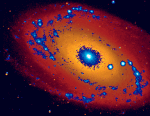
Few stars are still forming in the old giant spiral galaxy M81. The blue regions in this picture - representing ultraviolet light - highlight regions of bright young stars and star formation and appear rare than in M74 and M33. The red regions - representing the visible light - show a large population of older, less massive stars.
 Centaurus A: The Galaxy Deep Inside
2.02.2002
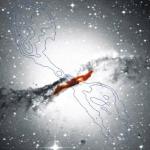
Deep inside Centaurus A, the closest active galaxy to Earth, lies ... another galaxy! Cen A is a giant elliptical galaxy a mere 10 million light-years distant with a central jumble of stars, dust, and gas that probably hides a massive black hole.
 Centaurus A: The Galaxy Deep Inside
4.12.1998
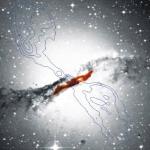
Deep inside Centaurus A, the closest active galaxy to Earth, lies ... another galaxy! Cen A is a giant elliptical galaxy a mere 10 million light-years distant with a central jumble of stars, dust, and gas that probably hides a massive black hole.
|
January February March April May June July August September October |
|||||||||||||||||||||||||||||||||||||||||||||||||