
|
You entered: rotation
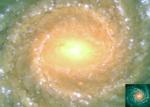 Spiral Galaxy NGC 1232
30.09.1998
Galaxies are fascinating not only for what is visible, but for what is invisible. Grand spiral galaxy NGC 1232, recently captured in detail by the new Very Large Telescope, is a good example.
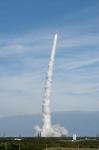 Swift Launches
21.11.2004
Where do gamma ray bursts occur? To help find out, NASA launched the Swift satellite on Saturday, as pictured above. What Swift is designed to do better than any previous satellite is to quickly locate these enigmatic explosions in both sky position and distance.
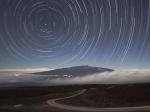 Star Trails Above Mauna Kea
19.12.2005
Is there a road to the stars? Possibly there are many, but the physical road pictured above leads up to the top of a dormant volcano that is a premier spot on planet Earth for observing stars and astronomical phenomena.
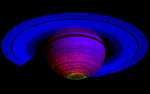 The Dancing Auroras of Saturn
27.09.2010
What drives auroras on Saturn? To help find out, scientists have sorted through hundreds of infrared images of Saturn taken by the Cassini spacecraft for other purposes, trying to find enough aurora images to correlate changes and make movies.
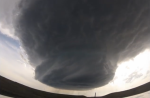 A Supercell Storm Cloud Forming over Wyoming
21.05.2014
How do supercell storm clouds form? Pictured above is a time-lapse video taken last Sunday detailing the formation of one such violent supercell in eastern Wyoming, USA. Starting as part of a large and dark thunderstorm complex, the supercell comes together along with a large rotating updraft of air known as a mesocyclone.
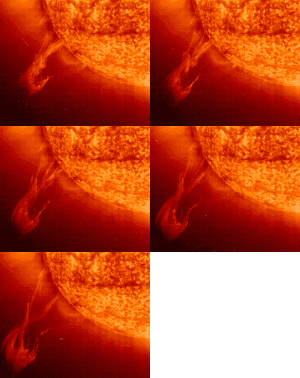 A Twisted Solar Eruptive Prominence
22.02.2003
A huge eruptive prominence is seen moving out from our Sun in this condensed half-hour time-lapse sequence. Ten Earths could easily fit in the "claw" of this seemingly solar monster. This large prominence, though, is significant not only for its size, but its shape.
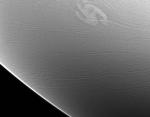 Saturn Storm by Ringshine
22.02.2006
Imaged on the night side of Saturn by the Cassini spacecraft, these swirling storm clouds are illuminated by ringshine - sunlight reflected from the gas giant's magnificent ring system. The storm (top) was actually spotted last month by amateur astronomers as it rotated across Saturn's day side and spans about 3,500 kilometers.
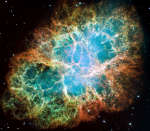 M1: The Crab Nebula from Hubble
25.12.2011
This is the mess that is left when a star explodes. The Crab Nebula, the result of a supernova seen in 1054 AD, is filled with mysterious filaments. The filaments are not only tremendously complex, but appear to have higher speed than expected from a free explosion.
 APOD: 2025 June 28 Б Lunar Farside
27.06.2025
Tidally locked in synchronous rotation, the Moon always presents its familiar nearside to denizens of planet Earth. From lunar orbit, the Moon's farside can become familiar, though. In fact this sharp picture, a mosaic from the Lunar Reconnaissance Orbiter's wide angle camera, is centered on the lunar farside.
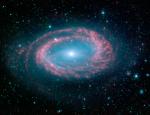 One Armed Spiral Galaxy NGC 4725
1.09.2005
While most spiral galaxies, including our own Milky Way, have two or more spiral arms, peculiar galaxy NGC 4725 has only one. In this false-color Spitzer Space Telescope infrared image, the galaxy's solo spira mirabilis is seen in red, highlighting the emission from dust clouds warmed by newborn stars.
|
January February March April May June July August |
||||||||||||||||||||||||||||||||||||||||||||||||||||||||