
|
You entered: star cluster
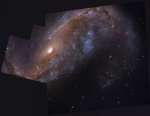 NGC 2442: Galaxy in Volans
25.03.2010
Distorted galaxy NGC 2442 can be found in the southern constellation of the flying fish, (Piscis) Volans. Located about 50 million light-years away, the galaxy's two spiral arms extending from a pronounced central bar have a hook-like appearance in wide-field images.
 A Flock of Stars
13.12.2003
Only a few stars can be found within ten light-years of our lonely Sun, situated near an outer spiral arm of the Milky Way galaxy. But if the Sun were found within one of our galaxy's star clusters, thousands of stars might occupy a similar space.
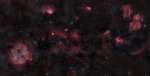 Cepheus: Trunk to Bubble
9.09.2010
Star clusters, glowing nebulae and dark dust clouds abound in Cepheus, royal constellation of the northern hemisphere. You can follow them in amazing detail across this broad skyscape, a mosaic of telescopic images spanning about 17 degrees. Beginning at the lower left, the large emission nebula is cataloged as IC 1396.
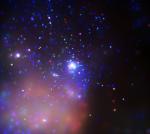 X Ray Portrait of Trumpler 14
2.09.2005
A wonder of planet Earth's southern sky, star cluster Trumpler 14 lies about nine thousand light-years away in the Carina complex -- a rich star forming region at the edge of a giant molecular cloud.
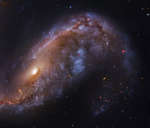 NGC 2442: Galaxy in Volans
17.08.2017
Distorted galaxy NGC 2442 can be found in the southern constellation of the flying fish, (Piscis) Volans. Located about 50 million light-years away, the galaxy's two spiral arms extending from a pronounced central bar have a hook-like appearance in wide-field images.
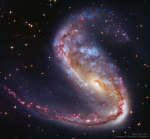 APOD: 2020 August 4 Б NGC 2442: Galaxy in Volans
4.08.2020
Distorted galaxy NGC 2442 can be found in the southern constellation of the flying fish, (Piscis) Volans. Located about 50 million light-years away, the galaxy's two spiral arms extending from a pronounced central bar have a hook-like appearance in wide-field images.
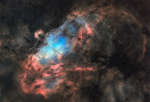 Portrait of the Eagle Nebula
12.08.2022
A star cluster around 2 million years young surrounded by natal clouds of dust and glowing gas, Messier 16 (M16) is also known as The Eagle Nebula. This beautifully detailed image of the region adopts the colorful Hubble palette and includes cosmic sculptures made famous in Hubble Space Telescope close-ups of the starforming complex.
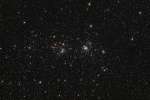 The Double Cluster
4.12.2009
A lovely starfield in the heroic northern constellation Perseus holds this famous pair of open or galactic star clusters, h and Chi Perseii. Also cataloged as NGC 869 (right) and NGC 884, both clusters are about 7,000 light-years away and contain stars much younger and hotter than the Sun.
 The Tadpoles of IC 410
18.06.2020
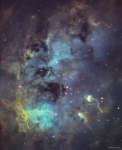
This telescopic close-up shows off the central regions of otherwise faint emission nebula IC 410, captured under backyard suburban skies with narrowband filters. It also features two remarkable inhabitants of the cosmic pond of gas and dust. Below and right of center are the tadpoles of IC 410.
 NGC 1893 and the Tadpoles of IC 410
2.02.2024
This cosmic view shows off an otherwise faint emission nebula IC 410, captured under clear Netherlands skies with telescope and narrowband filters. Above and right of center you can spot two remarkable inhabitants of the interstellar pond of gas and dust, known as the tadpoles of IC 410.
|
January February March April May June July August September October |
|||||||||||||||||||||||||||||||||||||||||||||||||