
|
You entered: star system
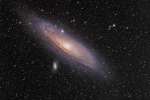 Andromeda Island Universe
9.01.2010
The most distant object easily visible to the eye is M31, the great Andromeda Galaxy some two and a half million light-years away. But without a telescope, even this immense spiral galaxy - spanning over 200,000 light years - appears as a faint, nebulous cloud in the constellation Andromeda.
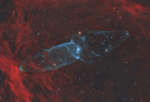 Ou4: The Giant Squid Nebula
12.10.2022
A mysterious squid-like cosmic cloud, this nebula is very faint, but also very large in planet Earth's sky. In the image, composed with 30 hours of narrowband image data, it spans nearly three full moons toward the royal constellation Cepheus.
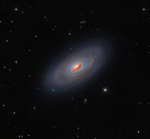 M64: The Black Eye Galaxy
18.06.2015
This big, bright, beautiful spiral galaxy is Messier 64, often called the Black Eye Galaxy or the Sleeping Beauty Galaxy for its heavy-lidded appearance in telescopic views. M64 is about 17 million light-years distant in the otherwise well-groomed northern constellation Coma Berenices.
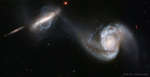 Arp 87: Merging Galaxies from Hubble
11.08.2019
This dance is to the death. Along the way, as these two large galaxies duel, a cosmic bridge of stars, gas, and dust currently stretches over 75,000 light-years and joins them. The bridge...
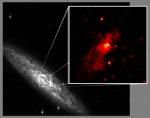 NGC 253: X Ray Zoom
7.06.2001
Astronomers now report that Chandra X-ray Observatory observations of galaxies known to be frantically forming stars show that these galaxies also contain luminous x-ray sources -- thought to be intermediate mass black holes and immense clouds of superheated gas. Take the lovely island universe NGC 253 for example.
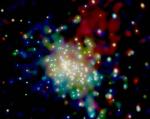 X Ray Mystery in RCW 38
27.12.2002
A mere 6,000 light-years distant and sailing through the constellation Vela, star cluster RCW 38 is full of powerful stars. It's no surprise that these stars, only a million years young with hot outer atmospheres, appear as point-like x-ray sources dotting this x-ray image from the orbiting Chandra Observatory.
 X Ray Mystery in RCW 38
8.01.2005
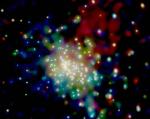
A mere 6,000 light-years distant and sailing through the constellation Vela, star cluster RCW 38 is full of powerful stars. It's no surprise that these stars, only a million years young with hot outer atmospheres, appear as point-like x-ray sources dotting this x-ray image from the orbiting Chandra Observatory.
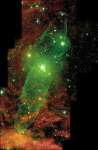 Ou4: A Giant Squid Nebula
18.07.2014
A mysterious, squid-like apparition, this nebula is very faint, but also very large in planet Earth's sky. In the mosaic image, composed with narrowband data from the 2.5 meter Isaac Newton Telescope, it spans some 2.5 full moons toward the constellation Cepheus.
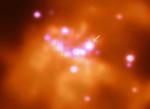 M82 s Middle Mass Black Hole
14.09.2000
Black holes are probably the most bizarre creatures in the modern astronomical zoo. And after years of pondering black holes as either stellar mass objects seen in binary star systems or enormous supermassive black holes at the centers of galaxies, astronomers now have strong evidence
 M81: Feeding a Black Hole
27.06.2008
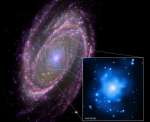
This impressive color composite shows spiral galaxy M81 across the electromagnetic spectrum. It combines X-ray data (blue) from the Chandra Observatory, infrared data (pink) from the Spitzer Space Telescope, and an ultraviolet image (purple) from the GALEX satellite, with a visible light (green) Hubble image.
|
January February March April May June July August September October |
|||||||||||||||||||||||||||||||||||||||||||||||||