
|
You entered: Earth
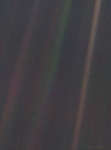 The Largest Rock in our Solar System
1.01.2023
There, that dot on the right, that's the largest rock known in our Solar System. It is larger than every known asteroid, moon, and comet nucleus. It is larger than any other local rocky planet.
 APOD: 2023 December 26 Б IC 443: The Jellyfish Nebula
26.12.2023
Why is this jellyfish swimming in a sea of stars? Drifting near bright star Eta Geminorum, seen at the right, the Jellyfish Nebula extends its tentacles from the bright arcing ridge of emission left of center.
 APOD: 2024 March 19 Б A Picturesque Equinox Sunset
19.03.2024
What's that at the end of the road? The Sun. Many towns have roads that run east-west, and on two days each year, the Sun rises and sets right down the middle. Today, in some parts of the world (tomorrow in others), is one of those days: an equinox.
 3 ATs
3 ATs
4.05.2024
Despite their resemblance to R2D2, these three are not the droids you're looking for. Instead, the enclosures house 1.8 meter Auxiliary Telescopes (ATs) at Paranal Observatory in the Atacama Desert region of Chile.
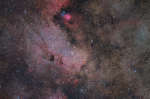 Messier 24: Sagittarius Star Cloud
18.07.2024
Unlike most entries in Charles Messier's famous catalog of deep sky objects, M24 is not a bright galaxy, star cluster, or nebula. It's a gap in nearby, obscuring interstellar dust clouds that allows a view of the distant stars in the Sagittarius spiral arm of our Milky Way galaxy.
 APOD: 2024 September 15 Б Find the Man in the Moon
15.09.2024
Have you ever seen the Man in the Moon? This common question plays on the ability of humans to see pareidolia -- imagining familiar icons where they don't actually exist. The textured surface...
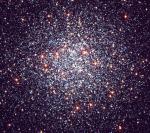 M55: Globular Star Cluster
22.09.2000
The fifty-fifth entry in Charles Messier's catalog, M55 is a large and lovely globular cluster of around 100,000 stars. Only 20,000 light-years away in the constellation Sagittarius, M55 appears to earth-bound observers to be nearly 2/3 the size of the full moon.
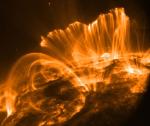 Coronal Rain, Solar Storm
15.11.2000
In this picture, the Sun's surface is quite dark. A frame from a movie recorded on November 9th by the orbiting TRACE telescope, it shows coronal loops lofted over a solar active region.
 Supernova 1987a Fireball Resolved
24.01.1997
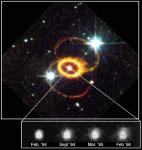
Ten years ago the most notable supernova of modern times was observed. In February 1987, light reached Earth from a star which exploded in the nearby Large Magellanic Cloud galaxy. Supernova 1987a remains the closest supernova since the invention of the telescope.
 D rad Bacteria: Candidate Astronauts
25.04.2004
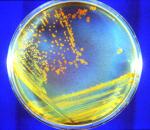
These bacteria could survive on another planet. In an Earth lab, Deinococcus radiodurans (D. rad) survive extreme levels of radiation, extreme temperatures, dehydration, and exposure to genotoxic chemicals. Amazingly, they even have the ability to repair their own DNA, usually with 48 hours. Known as an extremophile, bacteria such as D.
|
January February March April May June July August September October |
|||||||||||||||||||||||||||||||||||||||||||||||||