
|
You entered: stars
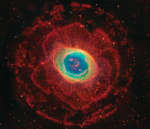 Rings Around the Ring Nebula
13.08.2014
It is a familiar sight to sky enthusiasts with even a small telescope. There is much more to the Ring Nebula (M57), however, than can be seen through a small telescope. The easily visible...
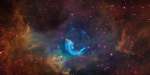 Approaching the Bubble Nebula
31.05.2017
What would it look like to approach the Bubble Nebula? Blown by the wind and radiation from a massive star, this bubble now spans seven light-years in diameter. The hot star inside is thousands of times more luminous than our Sun, and is now offset from the nebula's center.
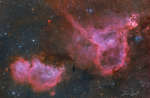 APOD: 2023 February 14 Б The Heart and Soul Nebulas
14.02.2023
Is the heart and soul of our Galaxy located in Cassiopeia? Possibly not, but that is where two bright emission nebulas nicknamed Heart and Soul can be found. The Heart Nebula, officially dubbed IC 1805 and visible in the featured image on the upper right, has a shape reminiscent of a classical heart symbol.
 APOD: 2025 April 16 Б Halo of the Cats Eye
16.04.2025
What created the unusual halo around the Cat's Eye Nebula? No one is sure. What is sure is that the Cat's Eye Nebula (NGC 6543) is one of the best known planetary nebulae on the sky.
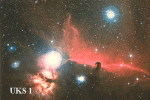 Orion's Horsehead Nebula
25.09.1995
The black indentation to the red emission nebula seen just to the right of center of the above photograph is one of the most famous features in any nebulae on the sky. Because of its shape, it is known as the Horsehead Nebula.
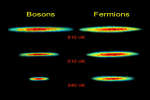 Pauli Exclusion Principle: Why You Don't Implode
28.02.2010
Why doesn't matter just bunch up? The same principle that keeps neutron stars and white dwarf stars from imploding also keeps people from imploding and makes normal matter mostly empty space. The observed reason is known as the Pauli Exclusion Principle.
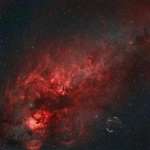 Nebulae in the Northern Cross
19.11.2010
Explore a beautiful and complex region of nebulae strewn along the plane of our Milky Way Galaxy in this widefield skyscape. The image emphasizes cosmic gas clouds in a 25 by 25 degree view centered on the Northern Cross, the famous asterism in the constellation Cygnus.
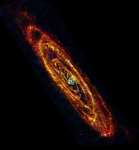 Herschel s Andromeda
2.02.2013
This infrared view from the Herschel Space Observatory explores the Andromeda Galaxy, the closest large spiral galaxy to our own Milky Way. Only 2.5 million light-years distant, the famous island universe is also known to astronomers as M31. Andromeda spans over 200,000 light-years making it more the twice the size of the Milky Way.
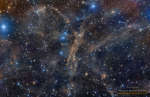 A Dust Angel Nebula
28.04.2016
The combined light of stars along the Milky Way are reflected by these cosmic dust clouds that soar some 300 light-years or so above the plane of our galaxy. Dubbed the Angel Nebula, the faint apparition is part of an expansive complex of dim and relatively unexplored, diffuse molecular clouds.
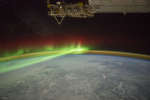 Aurora and Manicouagan Crater from the Space Station
29.05.2018
How many of these can you find in today's featured photograph: an aurora, airglow, one of the oldest impact craters on the Earth, snow and ice, stars, city lights, and part of the International Space Station? Most of these can be identified by their distinctive colors.
|
January February March April May June July August September October |
|||||||||||||||||||||||||||||||||||||||||||||||||