
|
You entered: Earth
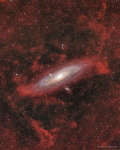 Clouds Around Galaxy Andromeda
24.10.2022
What are those red clouds surrounding the Andromeda galaxy? This galaxy, M31, is often imaged by planet Earth-based astronomers. As the nearest large spiral galaxy, it is a familiar sight with dark dust lanes, bright yellowish core, and spiral arms traced by clouds of bright blue stars.
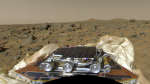 APOD: 2026 July 4 Б Pathfinder on Mars
4.07.2026
On July 4th, 1997, using its own array of fireworks, a parachute, and a cocoon of airbags, the Mars Pathfinder spacecraft bounced like a giant beach ball at least 15 times before it came to rest on the surface of Mars at 10:07 AM Pacific Daylight Time.
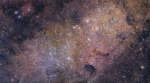 APOD: 2026 July 11 Б Messier 24: Sagittarius Star Cloud
11.07.2026
Unlike most entries in Charles Messier's famous catalog of deep sky objects, M24 is not a bright galaxy, star cluster, or nebula. It's a gap in nearby, obscuring interstellar dust clouds that allows a view of the distant stars in the Sagittarius spiral arm of our Milky Way galaxy.
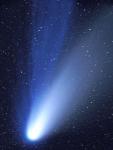 The Dust and Ion Tails of Comet Hale Bopp
27.12.2000
In 1977, Comet Hale-Bopp's intrinsic brightness exceeded any comet since 1811. Since it peaked on the other side of the Earth's orbit, however, the comet appeared only brighter than any comet in two decades. Visible above are the two tails shed by Comet Hale-Bopp.
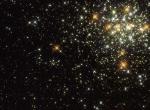 NGC 1818: A Young Globular Cluster
11.03.2001
Globular clusters once ruled the Milky Way. Back in the old days, back when our Galaxy first formed, perhaps thousands of globular clusters roamed our Galaxy. Today, there are perhaps 200 left. Many globular clusters were destroyed over the eons by repeated fateful encounters with each other or the Galactic center.
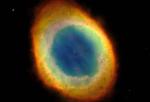 M57: The Ring Nebula
16.07.2000
Except for the rings of Saturn, The Ring Nebula (M57) is probably the most famous celestial band. This planetary nebula's simple, graceful appearance is thought to be due to perspective -- our view from planet Earth looking straight into what is actually a barrel-shaped cloud of gas shrugged off by a dying central star.
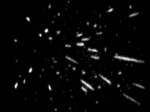 Quadrantids: Meteors in Perspective
26.01.1996
Meteor showers are caused by streams of solid particles, dust size and larger, moving as a group through space. In many cases, the orbits of these meteor streams can be identified with the dust tails of comets.
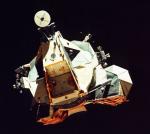 Apollo 17s Moonship
15.04.1999
Awkward and angular looking, Apollo 17's lunar module Challenger was designed for flight in the vacuum of space. This sharp picture from the command module America, shows Challenger's ascent stage in lunar orbit.
 Sol 4: Mars Color Panorama
9.07.1997
These mosaicked images form a color panorama of the region immediately surrounding the Sagan Memorial Station on Mars. The most recent images were recorded on Sol 4 - the 4th day of operations on the martian surface. The composite view reveals the reddish soil and rock-strewn terrain of an ancient martian flood channel.
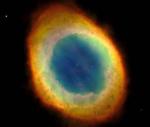 The Ring
7.01.1999
Except for the Rings of Saturn, The Ring Nebula (M57) is probably the most famous celestial band. This planetary nebula's simple, graceful appearance is thought to be due to perspective -- our view from planet Earth looking straight into what is actually a barrel-shaped cloud of gas shrugged off by a dying central star.
|
January February March April May June July August September October |
|||||||||||||||||||||||||||||||||||||||||||||||||