
|
You entered: sky
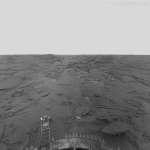 The Surface of Venus from Venera 13
17.03.2021
If you could stand on Venus -- what would you see? Pictured is the view from Venera 13, a robotic Soviet lander which parachuted and air-braked down through the thick Venusian atmosphere in March of 1982.
 APOD: 2023 November 21 Б Flemings Triangular Wisp
21.11.2023
These chaotic and tangled filaments of shocked, glowing gas are spread across planet Earth's sky toward the constellation of Cygnus as part of the Veil Nebula. The Veil Nebula itself is a large supernova remnant, an expanding cloud born of the death explosion of a massive star.
 Hickson 44 in Leo
4.04.2025
Scanning the skies for galaxies, Canadian astronomer Paul Hickson and colleagues identified some 100 compact groups of galaxies, now appropriately called Hickson Compact Groups. The four prominent galaxies seen in this intriguing telescopic skyscape are one such group, Hickson 44.
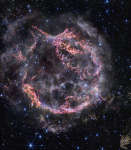 Supernova Remnant Cassiopeia A
6.02.2026
Massive stars in our Milky Way Galaxy live spectacular lives. Collapsing from vast cosmic clouds, their nuclear furnaces ignite and create heavy elements in their cores. After only a few million years for the most massive stars, the enriched material is blasted back into interstellar space where star formation can begin anew.
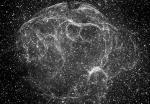 Simeis 147: Supernova Remnant
30.08.2002
It's easy to get lost following the intricate filaments in this stunningly detailed image of faint supernova remnant Simeis 147. Seen towards the constellation Taurus it covers nearly 3 degrees (6 full moons)...
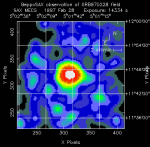 Gamma-Ray Burster
19.03.1997
What and where are the Gamma-Ray Bursters? Since their discovery in the early 1970s, nobody has been able to explain the cause of mysterious flashes of gamma rays that come from seemingly random directions on the sky.
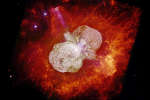 APOD: 2008 June 17- Eta Carinae and the Homunculus Nebula
17.06.2008
How did the star Eta Carinae create this unusual nebula? No one knows for sure. About 165 years ago, the southern star Eta Carinae mysteriously became the second brightest star in the night sky. In 20 years, after ejecting more mass than our Sun, Eta Car unexpected faded.
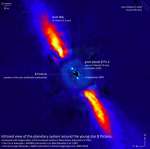 A Giant Planet for Beta Pic
3.07.2010
A mere 50 light-years away, young star Beta Pictoris became one of the most important stars in the sky in the early 1980s. Satellite and ground-based telescopic observations revealed the presence of a surrounding...
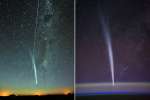 Comet Lovejoy and the ISS
31.12.2011
On December 24, Comet Lovejoy rose in dawn's twilight, arcing above the eastern horizon, its tails swept back by the solar wind and sunlight. Seen on the left is the comet's early morning appearance alongside the southern Milky Way from the town of Intendente Alvear, La Pampa province, Argentina.
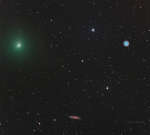 The Comet, the Owl, and the Galaxy
24.03.2017
Comet 41P/Tuttle-Giacobini-Kresak poses for a Messier moment in this telescopic snapshot from March 21. In fact it shares the 1 degree wide field-of-view with two well-known entries in the 18th century comet-hunting astronomer's famous catalog.
|
January February March April May June July August September October |
|||||||||||||||||||||||||||||||||||||||||||||||||