
|
You entered: Jupiter
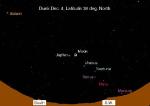 A Sky Full Of Planets
4.12.1997
Look up tonight. Just after sunset, the crescent moon and all five "naked-eye" planets (Mercury, Venus, Mars, Jupiter, and Saturn) will be visible (depending on your latitude), lying near our solar system's ecliptic plane.
 APOD: 2025 August 23 Б Fishing for the Moon
23.08.2025
How big is planet Earth's Moon? Compared to other moons of the Solar System, it's number 5 on the largest to smallest ranked list, following Jupiter's moon Ganymede, Saturn's moon Titan, and Jovian moons Callisto and Io. Continuing the list, the Moon comes before Jupiter's Europa and Neptune's Triton.
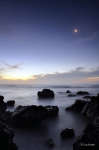 Conjunction Over Reunion Island
7.03.2012
You don't have to be on Reunion Island to see this week's planetary conjunction. Only if you want to see this picturesque seascape as well. To see the conjunction from just about anywhere in the world, look to the west after sunset.
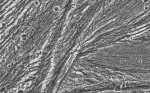 Galileo Photographs Ganymede
10.07.1996
Ganymede's surface is slowly being pulled apart. This photo of Ganymede was released earlier today by the Galileo team at NASA. The Galileo Spacecraft arrived at Jupiter in December 1995. In late June...
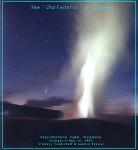 Old Faithful Meets Hale-Bopp
26.05.1997
As Comet Hale-Bopp leaves our Northern Skies, it provides us with yet another burst of joy. On May 11th the fading comet was photographed behind the famous "Old Faithful" water geyser of Yellowstone National Park, Wyoming, USA, Planet Earth.
 Io and Callisto Mutual Event
25.11.2014
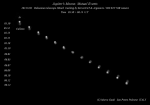
A 24 minute sequence from top to bottom, this intriguing series of telescopic frames tracks the occultation of Io by Callisto, two of Jupiter's Galilean moons, from San Pietro Polesine, Italy, planet Earth. A challenging observational project using a small telescope, the two contrasting Jovian worlds are both slightly larger than Earth's Moon.
 Children of the Sun
16.11.2006
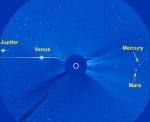
For a moment, planets Jupiter, Venus, Mars, and Mercury all posed near their parent star in this Sun-centered view, recorded on November 11. The picture, from a coronograph onboard the space-based SOlar Heliospheric Observatory, spans 15 degrees with the Sun's size and position indicated by the white circle.
 APOD: 2023 October 23 Б Moon Io from Spacecraft Juno
23.10.2023
There goes another one! Volcanoes on Jupiter's moon Io keep erupting. To investigate, NASA's robotic Juno spacecraft has begun a series of visits to this very strange moon. Io is about...
 APOD: 2023 October 10 Б Hidden Orion from Webb
10.10.2023
The Great Nebula in Orion has hidden stars. To the unaided eye in visible light, it appears as a small fuzzy patch in the constellation of Orion. But this image was taken by the Webb Space Telescope in a representative-color composite of red and very near infrared light.
 The Crater Chain
15.07.1995
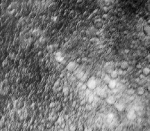
NASA's robot spaceprobe Voyager 1, took this closeup image of the surface of Jupiter's crater scarred moon Callisto in 1979. A mysterious chain of craters is seen to extend diagonally across the image (upper left to lower right). What could cause the craters to line up in such a regular fashion?
|
January February March April May June July August September October |
|||||||||||||||||||||||||||||||||||||||||||||||||