
|
You entered: Saturn's Moon
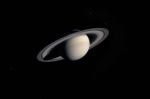 Cassini Approaches Saturn
10.12.2003
Cassini, a robot spacecraft launched in 1997 by NASA, is close enough now to resolve many rings and moons of its destination planet: Saturn. The spacecraft has now closed to within a single Earth-Sun separation from the ringed giant. Early last month, Cassini snapped the contrast-enhanced color composite pictured above.
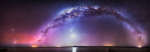 From the Northern to the Southern Cross
27.01.2014
There is a road that connects the Northern to the Southern Cross but you have to be at the right place and time to see it. The road, as pictured above, is actually...
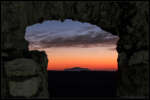 Venus and Mercury at Sunset
14.01.2015
Inner planets Venus and Mercury can never wander far from the Sun in Earth's sky. This week you've probably seen them both gathered near the western horizon just after sunset, a close conjunction of bright celestial beacons in the fading twilight.
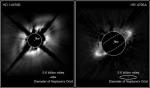 Possible Planets And Infrared Dust
20.01.1999
These near-infrared Hubble images of dust surrounding young stars offer the latest tantalizing evidence for planets beyond our Solar System. At left, the dark gap seen in the dust disk is reminiscent of a similar large gap in Saturn's rings believed to be sculpted by orbiting moons.
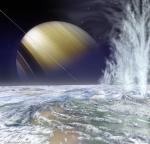 Enceladus Ice Volcanos
8.06.2006
In this stunning Saturnian vista - one in a series of artist's visions of volcanos on alien worlds - icy geysers erupt along narrow fractures in inner moon Enceladus. The majestic plumes were actually discovered by instruments on the Cassini Spacecraft during close encounters with bright and shiny Enceladus last year.
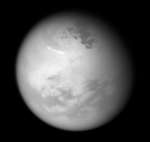 Northern Summer on Titan
22.06.2017
While yesterday's solstice brought summer to planet Earth's northern hemisphere, a northern summer solstice arrived for ringed planet Saturn nearly a month ago on May 24. Following the Saturnian seasons, its large moon Titan was captured in this Cassini spacecraft image from June 9.
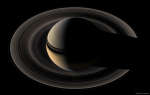 Crescent Saturn
8.08.2020
From Earth, Saturn never shows a crescent phase. But when viewed from a spacecraft the majestic giant planet can show just a sunlit slice. This image of crescent Saturn in natural color was taken by the robotic Cassini spacecraft in 2007.
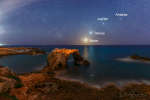 Celestial Alignment over Sicilian Shore
4.03.2019
This was a sunrise to remember. About a month ago, just before the dawn of the Sun, an impressive alignment of celestial objects was on display to the east. Pictured, brightest and closest to the horizon, is the Moon.
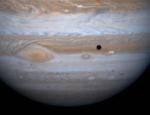 Jupiter, Io, and Shadow
7.12.2002
Pictured above is the innermost of Jupiter's Galilean satellites, Io, superposed in front of the gas giant planet. To the left of Io is a dark spot that is Io's own shadow. A solar eclipse would be seen from within the shadow spot on Jupiter.
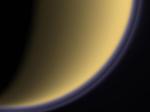 The Double Haze above Titan
10.08.2004
Most moons have no haze layer at all - why does Titan have two? Images from the Cassini spacecraft that slipped into orbit around Saturn last month confirm that the Solar System's most mysterious moon is surrounded not only by a thick atmosphere but also by two distinct spheres of haze.
|
January February March April May June July August September October |
|||||||||||||||||||||||||||||||||||||||||||||||||