
|
You entered: Solar System
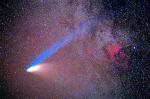 Hale Bopp and the North American Nebula
9.10.1997
Comet Hale-Bopp's recent encounter with the inner Solar System allowed many breath-taking pictures. Above, Comet Hale-Bopp was photographed on March 8th in the constellation of Cygnus. Visible on the right in red is the North American Nebula, a bright emission nebula observable from a dark location with binoculars.
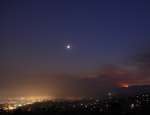 Planets and Fire by Moonlight
9.07.2008
On July 5th, wandering planets, bright stars, and a young crescent Moon graced western skies after sunset. Arrayed along the solar system's ecliptic plane, the three celestial beacons forming this skyscape's eye-catching line-up with the Moon are Saturn (upper left), then Mars, and finally Regulus, alpha star of the constellation Leo.
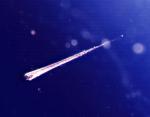 Catching Falling Stardust
17.11.2001
This carrot-shaped track is actually little more than 5 hundredths of an inch long. It is the trail of a meteroid through the high-tech substance aerogel exposed to space by the shuttle launched EURECA (European Recoverable Carrier) spacecraft.
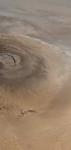 Olympus Mons From Orbit
19.10.1998
Olympus Mons on Mars is the largest volcano in the Solar System. Although three times higher than Earth's Mount Everest, Olympus Mons would not be difficult to climb because of the volcano's great breadth.
 On the Origin of Gold
18.05.2008
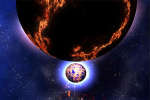
Where did the gold in your jewelry originate? No one is completely sure. The relative average abundance in our Solar System appears higher than can be made in the early universe, in stars, and even in typical supernova explosions.
 Tharsis Volcanos
18.06.1999
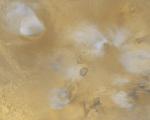
Ice crystal clouds float above the immense Tharsis volcanos of Mars in this recently released picture from NASA's Mars Global Surveyor spacecraft. Olympus Mons at the upper left is 340 miles across and almost 15 miles high - the largest volcano in the solar system.
 Crescent Neptune and Triton
25.07.2021
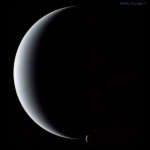
Gliding silently through the outer Solar System, the Voyager 2 spacecraft camera captured Neptune and Triton together in crescent phase. The elegant picture of the gas giant planet and its cloudy moon was taken from behind just after closest approach in 1989.
 The Millennium that Defined Earth
31.12.2000
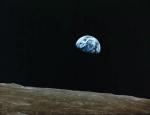
When the second millennium began, people generally knew that the Earth was round, but few saw much of it beyond their local village. As the millennium progressed, humans mapped the continents, circumnavigated the globe, and determined the composition of the Earth.
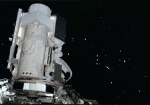 Astro 1 In Orbit
4.05.1996
In December of 1990, the Space Shuttle Columbia carried an array of astronomical telescopes high above the Earth's obscuring atmosphere to observe the Universe at ultraviolet and x-ray wavelengths. The telescopes, known...
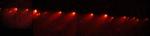 A String Of Pearls
24.07.2004
Comet Shoemaker-Levy 9, named after its co-discoverers, was often referred to as the "string of pearls" comet. It is famous for its suggestive appearance as well as its collision with the planet Jupiter!
|
January February March April May June July August |
||||||||||||||||||||||||||||||||||||||||||||||||||||||||