
|
You entered: arcs
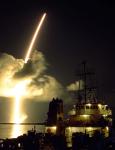 Cassini To Venus
16.10.1997
NASA's Saturn Explorer Cassini with ESA's Titan Probe Huygens attached successfully rocketed into the skies early yesterday morning. The mighty Titan 4B Centaur rocket is seen here across the water gracefully arcing away from Launch Complex 40 at Cape Canaveral Air Station.
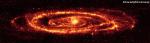 The Andromeda Galaxy in Infrared
20.10.2005
What is the Andromeda galaxy really like? To find out, astronomers looked at our largest galactic neighbor in a different light: infrared. Astronomers trained the orbiting Spitzer Space Telescope at the Messier monster (M31) for over 18 hours, creating a mosaic that incorporated 11,000 separate exposures.
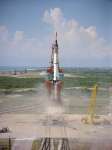 50 Years Ago: Freedom 7 Flies
5.05.2011
Fifty years ago, near the dawn of the space age, NASA controllers "lit the candle" and sent Mercury astronaut Alan Shepard arcing into space atop a Redstone rocket. His cramped space capsule was dubbed Freedom 7.
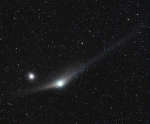 Comet Garradd and M92
4.02.2012
Sweeping slowly through the constellation Hercules, Comet Garradd (C2009/P1) passed with about 0.5 degrees of globular star cluster M92 on February 3. Captured here in its latest Messier moment, the steady performer remains just below naked-eye visibility with a central coma comparable in brightness to the dense, well-known star cluster.
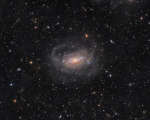 Curly Spiral Galaxy M63
4.12.2020
A bright spiral galaxy of the northern sky, Messier 63 is nearby, about 30 million light-years distant toward the loyal constellation Canes Venatici. Also cataloged as NGC 5055, the majestic island universe is nearly 100,000 light-years across, about the size of our own Milky Way.
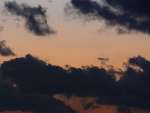 At first he couldn t see the Moon
11.04.2008
At first, he couldn't see it, but searching with binoculars along a cloudy western horizon near sunset, photographer Laurent Laveder finally spotted a delicate lunar crescent. Captured in this dramatic picture on April 6th from Bretagne, France, the Moon was only 15 hours and 38 minutes old.
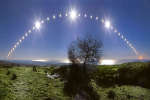 Tyrrhenian Sea and Solstice Sky
21.12.2010
Today the solstice occurs at 23:38 Universal Time, the Sun reaching its southernmost declination in planet Earth's sky. Of course, the December solstice marks the beginning of winter in the northern hemisphere and summer in the south.
 Gemini Observatory North
15.10.2016
It does look like a flying saucer, but this technologically advanced structure is not here to deliver the wise extraterrestrial from the scifi classic movie The Day the Earth Stood Still. It is here to advance our knowledge of the Universe though.
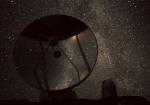 La Silla s Starry Night
23.09.2004
On clear, moonless nights, the stars still come out with a vengance above the high-altitude La Silla astronomical observatory. Taking advantage of a recent visit to this first European Southern Observatory (ESO) site constructed on a mountain top in Chile, ESO software engineer Nico Housen recorded this stunning sky view.
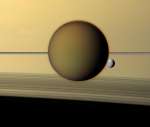 Ringside with Titan and Dione
5.01.2012
Orbiting in the plane of Saturn's rings, Saturnian moons have a perpetual ringside view of the gorgeous gas giant planet. Of course, while passing near the ring plane the Cassini spacecraft also shares their stunning perspective.
|
January February March April May June July August September |
|||||||||||||||||||||||||||||||||||||||||||||||||