
|
You entered: comet tail
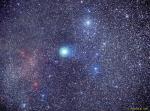 Skyscape with Comet Holmes
9.11.2007
This gorgeous skyscape spans some 10 degrees across the heroic constellation Perseus, about the size of a generous binocular field of view. The deep exposure includes bright stars, emission nebulae, star clusters, and, of course, the famous Comet Holmes. To identify the celestial landmarks, just place your cursor over the image.
 Comet Pons-Brooks at Night
4.04.2024
In dark evening skies over June Lake, northern hemisphere, planet Earth, Comet 12P/Pons-Brooks stood just above the western horizon on March 30. Its twisted turbulent ion tail and diffuse greenish coma are captured in this two degree wide telescopic field of view along with bright yellowish star Hamal also known as Alpha Arietis.
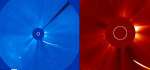 Surprising Comet ISON
30.11.2013
After failing to appear for Sun staring spacecraft at perihelion, its harrowing closest approach to the Sun, sungrazing Comet ISON was presumed lost. But ISON surprised observers yesterday as material still traveling along the comet's trajectory became visible and even developed an extensive fan-shaped dust tail.
 APOD: 2023 September 11 Б Beautiful Comet Nishimura
11.09.2023
This scene would be beautiful even without the comet. By itself, the sunrise sky is an elegant deep blue on high, with faint white stars peeking through, while near the horizon is a pleasing tan.
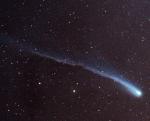 Comet Ikeya Zhang Brightens
7.03.2002
In the last week, Comet Ikeya-Zhang has become bright enough to be just visible to the unaided eye. Based on its present activity, observers are optimistic that Ikeya-Zhang will become substantially brighter. This composite...
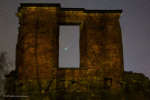 Comet Lovejoy through Morby Castle Ruins
4.12.2013
This new comet is quite photogenic. Comet Lovejoy, discovered only three months ago, was imaged through ruins of ancient MЖrby Castle in Sweden last week sporting a green-glowing coma and tails trailing several degrees.
 Comet McNaught Hartley
14.03.2001
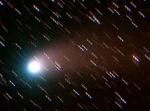
Outbound and climbing above the plane of our solar system, comet McNaught-Hartley (C/1999 T1) is presently soaring through northern skies. This telescopic picture, a composite of many 30 second exposures made through three color filters, recorded the delicate colors in its diminutive coma and faint tail on February 26th.
 APOD: 2025 November 25 Б Comet Lemmon and the Milky Way
25.11.2025
What did Comet Lemmon look like when it was at its best? One example is pictured here, featuring three celestial spectacles all at different distances. The closest spectacle is the snowcapped Meili Mountains, part of the Himalayas in China.
 Blue Comet in the Hyades
18.01.2018
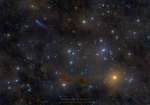
Stars of the Hyades cluster are scattered through this mosaic spanning over 5 degrees on the sky toward the constellation Taurus. Presently cruising through the Solar System, the remarkably blue comet C/2016 R2 PanSTARRS is placed in the wide field of view using image data from January 12.
 Introducing Comet ISON
1.10.2012
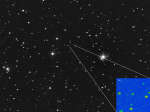
Could this dim spot brighten into one of the brightest comets ever? It's possible. Alternatively, the comet could break up when it gets closer to the Sun, or brighten much more modestly.
|
January February March April May June July August September |
|||||||||||||||||||||||||||||||||||||||||||||||||