
|
You entered: dark nebula
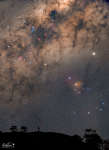 The Galaxy Above
15.10.2019
Have you contemplated your home galaxy lately? If your sky looked like this, perhaps you'd contemplate it more often! The featured picture is actually a composite of two images taken last month from the same location in south Brazil and with the same camera -- but a few hours apart.
 APOD: 2025 May 13 Б Gaia Reconstructs a Top View of our Galaxy
13.05.2025
What does our Milky Way Galaxy look like from the top? Because we are on the inside, humanity canБt get an actual picture. Recently, however, just such a map has been made using location data for over a billion stars from ESAБs Gaia mission.
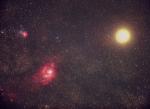 Messiers and Mars
28.06.2003
A telescopic tour of the constellation Sagittarius offers the many bright clusters and nebulae of dimensioned space in a starscape surrounding the galactic center. This gorgeous color deep-sky photograph visits two such lovely sights, cataloged by the 18th century cosmic tourist Charles Messier as M8 and M20.
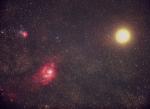 Messiers and Mars
15.06.2001
A telescopic tour of the constellation Sagittarius offers the many bright clusters and nebulae of dimensioned space in a starscape surrounding the galactic center. This gorgeous color deep-sky photograph visits two such lovely sights, cataloged by the 18th century cosmic tourist Charles Messier as M8 and M20.
 APOD: 2023 July 17 Б Shells and Arcs around Star CW Leonis
17.07.2023
What's happening around this star? No one is sure. CW Leonis is the closest carbon star, a star that appears orange because of atmospheric carbon dispersed from interior nuclear fusion. But CW Leonis also appears engulfed in a gaseous carbon-rich nebula.
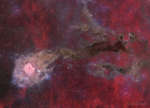 Cocoon Nebula Wide Field
26.10.2022
When does a nebula look like a comet? In this crowded starfield, covering over two degrees within the high flying constellation of the Swan (Cygnus), the eye is drawn to the Cocoon Nebula.
 A December Summer Night
23.12.2023
Colours of a serene evening sky are captured in this 8 minute exposure, made near this December's solstice from New Zealand, southern hemisphere, planet Earth. Looking south, star trails form the short concentric arcs around the rotating planet's south celestial pole positioned just off the top of the frame.
 M57: The Ring Nebula
16.07.2000
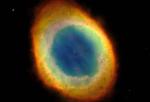
Except for the rings of Saturn, The Ring Nebula (M57) is probably the most famous celestial band. This planetary nebula's simple, graceful appearance is thought to be due to perspective -- our view from planet Earth looking straight into what is actually a barrel-shaped cloud of gas shrugged off by a dying central star.
 The Ring
7.01.1999
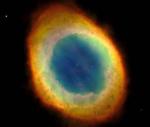
Except for the Rings of Saturn, The Ring Nebula (M57) is probably the most famous celestial band. This planetary nebula's simple, graceful appearance is thought to be due to perspective -- our view from planet Earth looking straight into what is actually a barrel-shaped cloud of gas shrugged off by a dying central star.
 Hidden Treasures of M78
27.01.2011
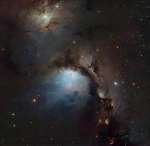
M78 isn't really hiding in planet Earth's night sky. About 1,600 light-years away and nestled in the nebula rich constellation Orion, the large, bright, reflection nebula is well-known to telescopic skygazers. But this gorgeous image of M78 was selected as the winner of the Hidden Treasures 2010 astrophotography competition.
|
January February March April May June July August September October |
|||||||||||||||||||||||||||||||||||||||||||||||||