
|
You entered: group of galaxies
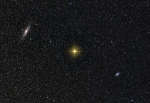 M31 versus M33
26.09.2015
Separated by about 14 degrees (28 Full Moons) in planet Earth's sky, spiral galaxies M31 at left, and M33 are both large members of the Local Group, along with our own Milky Way galaxy.
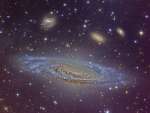 Beautiful Spiral NGC 7331
22.10.2008
A favorite target for astronomers, big, beautiful spiral galaxy NGC 7331 is one of the brighter galaxies not found in Charles Messier's famous 18th century catalog. About 50 million light-years distant...
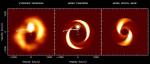 IP Pegasi: Spiral Star
22.08.1997
Spiral arms aren't just for galaxies. A hot disk of gas surrounding a compact white dwarf star in the constellation of Pegasus has recently been revealed to be imprinted with this dramatic pattern.
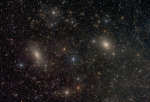 NGC 147 and NGC 185
4.11.2021
Dwarf galaxies NGC 147 (left) and NGC 185 stand side by side in this sharp telescopic portrait. The two are not-often-imaged satellites of M31, the great spiral Andromeda Galaxy, some 2.5 million light-years away.
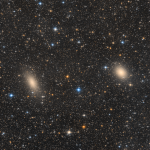 NGC 147 and NGC 185
13.02.2026
Dwarf galaxies NGC 147 (left) and NGC 185 stand side by side in this deep telescopic portrait. The two are not-often-imaged satellite galaxies of M31, the great spiral Andromeda Galaxy, some 2.5 million light-years away.
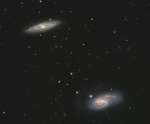 M65 and M66
15.06.2012
Nearby and bright, spiral galaxies M65 (top) and M66 stand out in this engaging cosmic snapshot. The pair are just 35 million light-years distant and around 100,000 light-years across, about the size of our own spiral Milky Way.
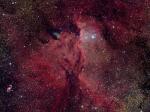 Reflections on NGC 6188
1.06.2006
NGC 6188 is an interstellar carnival of young blue stars, hot red gas, and cool dark dust. Located 4,000 light years away in the disk of our Galaxy, NGC 6188 is home to the Ara OB1 association, a group of bright young stars whose nucleus forms the open cluster NGC 6193.
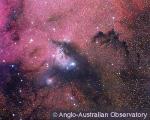 Reflections on NGC 6188
25.08.1999
NGC 6188 is an interstellar carnival of young blue stars, hot red gas, and cool dark dust. Located 4000 light years away in the disk of our Galaxy, NGC 6188 is home to the Ara OB1 association, a group of bright young stars whose nucleus forms the open cluster NGC 6193.
 IC 1396 and Surrounding Starfield
19.08.2009
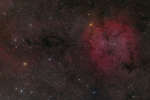
Sprawling across hundreds of light-years, emission nebula IC 1396, visible on the upper right, mixes glowing cosmic gas and dark dust clouds. Stars are forming in this area, only about 3,000 light-years from Earth. This wide angle view also captures surrounding emission and absorption nebula.
 Shell Galaxy NGC 7600
23.12.2011
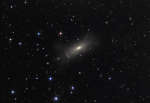
Similar in size to the Milky Way, elliptical galaxy NGC 7600 is about 150 thousand light-years distant. In this deep image, spanning about 1/2 degree on the sky toward the constellation Aquarius, NGC 7600 sports a remarkable outer halo of nested shells and broad circumgalactic structures.
|
January February March April May June July August September October |
|||||||||||||||||||||||||||||||||||||||||||||||||