
|
You entered: rings
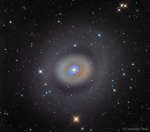 Starburst Galaxy M94
26.05.2015
What could cause the center of M94 to be so bright? Spiral galaxy M94 has a ring of newly formed stars surrounding its nucleus, giving it not only an unusual appearance but also a strong interior glow.
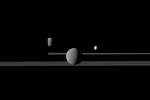 Ringside with Rhea
29.03.2013
Orbiting in the plane of Saturn's rings, Saturnian moons have a perpetual ringside view of the gas giant planet. Of course, while passing near the ring plane the Cassini spacecraft also shares their stunning perspective. The thin rings themselves slice across the middle of this Cassini snapshot from April 2011.
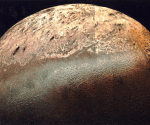 Triton: Neptune's Largest Moon
23.11.1997
On October 10th, 1846, William Lassell was observing the newly discovered planet Neptune. He was attempting to confirm his observation, made just the previous week, that Neptune had a ring. But this time he discovered that Neptune had a satellite as well.
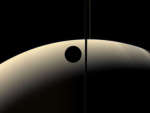 Crescent Rhea Occults Crescent Saturn
3.01.2015
Soft hues, partially lit orbs, a thin trace of the ring, and slight shadows highlight this understated view of the majestic surroundings of the giant planet Saturn. Looking nearly back toward the Sun, the robot Cassini spacecraft now orbiting Saturn captured crescent phases of Saturn and its moon Rhea in color a few years ago.
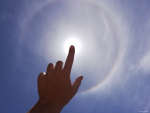 Circular Sun Halo
10.06.2021
Want to see a ring around the Sun? It's easy to do in daytime skies around the world. Created by randomly oriented ice crystals in thin high cirrus clouds, circular 22 degree halos are visible much more often than rainbows. This one was captured by smart phone photography on May 29 near Rome, Italy.
 Diamonds in the Sky
20.04.2024
When the dark shadow of the Moon raced across North America on April 8, sky watchers along the shadow's narrow central path were treated to a total solar eclipse. During the New Moon's shadow play diamonds glistened twice in the eclipse-darkened skies.
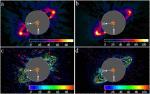 HR 4796A: Not Saturn
5.02.1999
These are not false-color renderings of the latest observations of Saturn's magnificent rings. Instead, the panels show a strikingly similar system on a much larger scale - a ring around the young, Vega-like star, HR 4796A, located about 200 light-years from Earth.
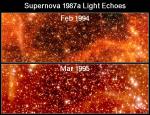 Moving Echoes Around SN 1987A
24.10.1997
Yesterday's image highlighted reflective rings of light emitted by a supernova explosion. Today's pictures, taken over a year apart, highlight how these echoes are seen to move over time. Visible...
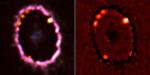 New Shocks For Supernova 1987A
17.02.2000
In February of 1987, astronomers witnessed the brightest supernova of modern times - supernova 1987A in the Large Magellanic Cloud. Mysterious rings of material surrounding the expanding stellar debris were soon emitting a visible glow excited by intense light from the explosion.
 Saturn at Night
12.09.2006
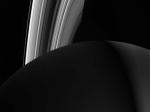
This is what Saturn looks like at night. In contrast to the human-made lights that cause the nighttime side of Earth to glow faintly, Saturn's faint nighttime glow is primarily caused by sunlight reflecting off of its own majestic rings.
|
January February March April May June July August September October |
|||||||||||||||||||||||||||||||||||||||||||||||||