
|
You entered: solar eclipse
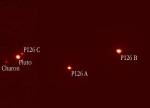 Pluto and Charon Eclipse a Triple Star
11.09.2002
Occasionally, a planet in our Solar System will pass in front of a bright star. Since stars and planets take up so little space on the sky, such events are quite rare. Two months ago, however, Pluto and its large moon Charon passed in front of a comparatively bright triple star system known as P126.
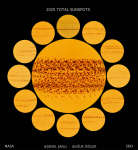 APOD: 2026 February 11 Б A Year of Sunspots
11.02.2026
How many sunspots can you see? The central image shows the many sunspots that occurred in 2025, month by month around the circle, and all together in the grand central image. Each sunspot is magnetically cooled and so appears dark -- and can last from days to months.
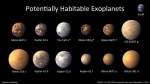 Habitable Worlds
3.03.2014
Is Earth the only known world that can support life? In an effort to find life-habitable worlds outside our Solar System, stars similar to our Sun are being monitored for slight light decreases that indicate eclipsing planets. Many previously-unknown planets are being found, including over 700 worlds recently uncovered by NASA's Kepler satellite.
 APOD: 2025 January 15 Б Wolf Moon Engulfs Mars
15.01.2025
Does the Moon ever engulf Mars? Yes, but only in the sense that it moves in front, which happens on rare occasions. This happened just yesterday, though, as seen from some locations in North America and western Africa.
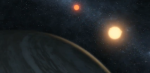 Kepler 16b: A Planet with Two Suns
20.09.2011
If you stay up long enough, you can watch both suns set. Such might be a common adage from beings floating in the atmosphere of Kepler 16b, a planet recently discovered by the space-based Kepler satellite. The above animated video shows how the planetary system might look to a visiting spaceship.
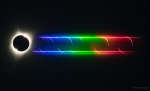 The Flash Spectrum of the Sun
7.09.2017
In clear Madras, Oregon skies, this colorful eclipse composite captured the elusive chromospheric or flash spectrum of the Sun. Only three exposures, made on August 21 with telephoto lens and diffraction grating, are aligned in the frame.
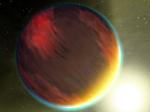 Atmospheres Detected on Two Extrasolar Planets
27.02.2007
Do extrasolar planets have water? In an attempt to find out, the orbiting Spitzer Space Telescope made detailed observations of the atmospheres of two planets that orbit stars other than our Sun. Unfortunately, water vapor was not detected in either exoplanet.
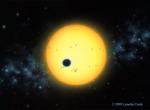 In the Shade of a Historic Planet
15.11.1999
For the first time, astronomers have recovered independent evidence that distant planetary systems exist. Last Friday, a team led by G. W. Henry (Tenn. State) and G. Marcy (UC Berkeley) announced the discovery of a shadow of a planet crossing a distant star.
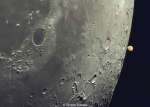 APOD: 2020 August 15 Б Mars at the Moons Edge
15.08.2020
Does the Moon ever block out Mars? Yes, the Moon occasionally moves in front of all of the Solar System's planets. Just this past Sunday, as visible from some locations in South America, a waning gibbous Moon eclipsed Mars.
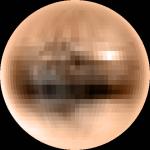 Pluto in True Color
19.03.2001
Pluto is mostly brown. The above picture captures the true colors of Pluto as well as the highest surface resolution so far recovered. No spacecraft has yet visited this most distant planet in our Solar System.
|
January February March April May June July August September |
|||||||||||||||||||||||||||||||||||||||||||||||||