
|
You entered: Earth
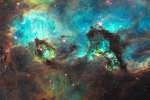 The Seahorse of the Large Magellanic Cloud
23.03.2009
To some it may look to some like a big space monster, but it is more big than monster. To others it may look like a grazing seahorse, but the dark object toward the image right is actually an inanimate pillar of smoky dust about 20 light years long.
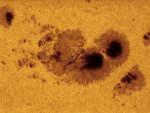 AR1520: Islands in the Photosphere
14.07.2012
Awash in a sea of plasma and anchored in magnetic fields, sunspots are planet-sized, dark islands in the solar photosphere, the bright surface of the Sun. Dark because they are slightly cooler than the surrounding surface, this group of sunspots is captured in a close-up telescopic snapshot from July 11.
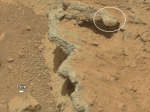 An Ancient Stream Bank on Mars
2.10.2012
Fresh evidence of an ancient stream has been found on Mars. The robotic rover Curiosity has run across unusual surface features that carry a strong resemblance to stream banks on Earth. Visible in the above image, for example, is a small overhanging rock ledge that was quite possibly created by water erosion beneath.
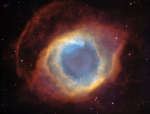 The Helix Nebula from Blanco and Hubble
12.10.2014
How did a star create the Helix nebula? The shapes of planetary nebula like the Helix are important because they likely hold clues to how stars like the Sun end their lives. Observations...
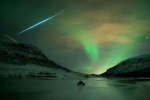 Aurora Shimmer Meteor Flash
6.12.2014
Northern Lights, or aurora borealis, haunted skies over the island of Kvaløya, near Tromsø Norway on 2009 December 13. This 30 second long exposure records their shimmering glow gently lighting the wintery coastal scene.
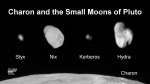 Charon and the Small Moons of Pluto
26.10.2015
What do the moons of Pluto look like? Before a decade ago, only the largest moon Charon was known, but never imaged. As the robotic New Horizons spacecraft was prepared and launched, other moons were identified on Hubble images but remained only specks of light.
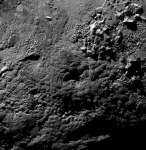 Wright Mons on Pluto
14.11.2015
Long shadows are cast by a low Sun across this rugged looking terrain. Captured by New Horizons, the scene is found just south of the southern tip Sputnik Planum, the informally named smooth, bright heart region of Pluto.
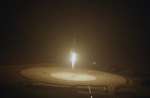 Falcon 9 First Stage Landing
28.12.2015
The booster has landed. Spaceflight took a step toward the less expensive last week when the first stage of a Falcon 9 rocket set down on a landing pad not far from its Florida launch.
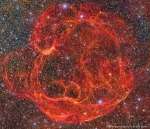 Simeis 147: Supernova Remnant
25.04.2016
It's easy to get lost following the intricate strands of the Spaghetti Nebula. A supernova remnant cataloged as Simeis 147 and Sh2-240, the glowing gas filaments cover nearly 3 degrees -- 6 full moons -- on the sky. That's about 150 light-years at the stellar debris cloud's estimated distance of 3,000 light-years.
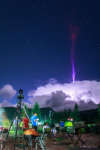 Gigantic Jet Lightning over China
23.08.2016
That's no meteor. While watching and photographing this year's Perseid Meteor Shower, something unexpected happened: a gigantic jet erupted from a nearby cloud. The whole thing was over in a flash -- it lasted less than a second -- but was fortunately captured by an already-recording digital camera.
|
January February March April May June July August September October |
|||||||||||||||||||||||||||||||||||||||||||||||||