
|
You entered: satellite
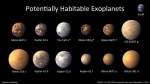 Habitable Worlds
3.03.2014
Is Earth the only known world that can support life? In an effort to find life-habitable worlds outside our Solar System, stars similar to our Sun are being monitored for slight light decreases that indicate eclipsing planets. Many previously-unknown planets are being found, including over 700 worlds recently uncovered by NASA's Kepler satellite.
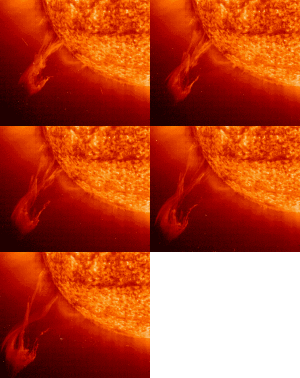 A Twisted Solar Eruptive Prominence
24.01.2015
Ten Earths could easily fit in the "claw" of this seemingly solar monster. The monster, actually a huge eruptive prominence, is seen moving out from our Sun in this condensed half-hour time-lapse sequence. This large prominence, though, is significant not only for its size, but its shape.
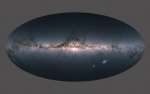 Gaia's Milky Way
26.04.2018
This grand allsky view of our Milky Way and nearby galaxies is not a photograph. It's a map based on individual measurements for nearly 1.7 billion stars. The astronomically rich data set used...
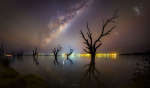 Dark Sky Reflections
28.06.2020
When the lake calmed down, many wonders of the land and sky appeared twice. Perhaps the most dramatic from the dark sky was the central band of our Milky Way Galaxy, visible as a diagonal band. Toward the right were both the Small (SMC) and Large (LMC) Magellanic Clouds, satellite galaxies of our Milky Way.
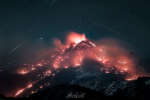 Stars over an Erupting Volcano
2.03.2021
Mt. Etna has been erupting for hundreds of thousands of years. Located in Sicily, Italy, the volcano produces lava fountains over one kilometer high. Mt. Etna is not only one of the most active...
 Earth at Night
10.08.2002
This is what the Earth looks like at night. Can you find your favorite country or city? Surprisingly, city lights make this task quite possible. Human-made lights highlight particularly developed or populated areas of the Earth's surface, including the seaboards of Europe, the eastern United States, and Japan.
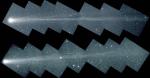 Comet NEAT Approaches the Sun
9.02.2003
A comet may likely become visible to the unaided eye over the next few days above the horizon where the Sun has just set. Comet NEAT (C/ 2002 V1), discovered last November, has brightened dramatically as it approached the Sun.
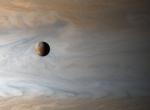 Io: Moon Over Jupiter
20.04.2001
How big is the Jovian moon Io? The most volcanic body in the Solar System, Io (usually pronounced "EYE-oh") is 3,600 kilometers in diameter, about the size of planet Earth's single large natural satellite.
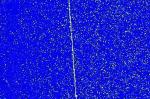 An Anomalous SETI Signal
28.07.2002
No one knows for sure what caused this signal. There is a slight possibility that it just might originate from an extraterrestrial intelligence. The bright colors on the blue background indicate that an anomalous signal was received here on Earth by a radio telescope involved in a Search for Extraterrestrial Intelligence (SETI).
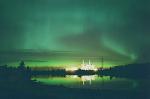 Aurora Over Edmonton
3.11.2003
Northern and southern locales saw many a beautiful aurora over the last week, as particles from several large solar flares impacted the Earth. Many reported unusually red auroras, although colors across the spectrum were also seen. Power grids and orbiting satellites braced for the onslaught, but little lasting damage was reported.
|
January February March April May June July August |
||||||||||||||||||||||||||||||||||||||||||||||||||||||||