
|
You entered: Earth
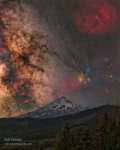 A Furious Sky over Mount Shasta
28.09.2022
Is the sky angry with Mount Shasta? According to some ancient legends, the spirits of above and below worlds fight there, sometimes quite actively during eruptions of this enormous volcano in California, USA. Such drama can well be imagined in this deep sky image taken in late June.
 APOD: 2023 July 23 Б The Antikythera Mechanism
23.07.2023
It does what? No one knew that 2,000 years ago, the technology existed to build such a device. The Antikythera mechanism, pictured, is now widely regarded as the first computer. Found...
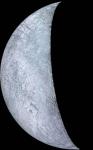 Crescent Europa
25.02.2002
Although the phase of this moon might appear familiar, the moon itself might not. In fact, this crescent shows part of Jupiter's moon Europa. The passing robot spacecraft Voyager 2 captured this image in 1979.
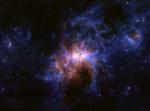 Dusty Environs of Eta Carinae
10.10.2002
Eta Car is a massive star, but it's not as bright as it used to be. Now only easily visible in binoculars or a small telescope, Eta Carinae has a history of spectacular flaring and fading behavior.
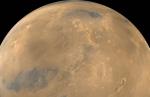 Five to Mars
2.05.2003
Come December 2003 - January 2004, an armada of five new invaders from Earth should arrive on the shores of the Red Planet -- the Japanese ( ISAS) Nozomi orbiter, the European Space Agency's Mars Express orbiter carrying the Beagle 2 lander, and NASA's own two Mars Exploration Rovers.
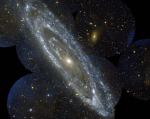 The Andromeda Galaxy from GALEX
22.12.2003
Why does the Andromeda Galaxy have a giant ring? Viewed in ultraviolet light, the closet major galaxy to our Milky Way Galaxy looks more like a ring galaxy than a spiral. The ring...
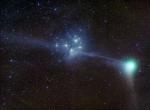 Machholz Meets the Pleiades
11.01.2005
Sweeping northward in planet Earth's sky, comet Machholz extended its long ion tail with the Pleiades star cluster in the background on January 7th. This stunning view, recorded with a telephoto lens in skies over Oberjoch, Bavaria, Germany, emphasizes faint, complex tail structures and the scene's lovely blue and green colors.
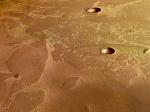 Unusual Plates on Mars
28.02.2005
What are those unusual plates on Mars? A leading current interpretation holds that they are blocks of ice floating on a recently frozen sea covered by dust. The unusual plates were photographed recently by the European Space Agency's Mars Express spacecraft currently orbiting Mars.
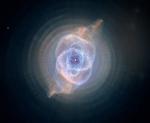 Cat s Eye
24.09.2005
Staring across interstellar space, the alluring Cat's Eye nebula lies three thousand light-years from Earth. A classic planetary nebula, the Cat's Eye (NGC 6543) represents a final, brief yet glorious phase in the life of a sun-like star.
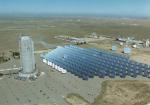 The 220 Mirrors of CRTF
4.10.1999
Even the largest of modern optical telescopes are small when compared with the light gathering power of the Central Receiver Test Facility (CRTF) located in New Mexico, USA. CRTF has 220 mirrors each over 7-meters in diameter all focused on a single tower.
|
January February March April May June July August September October |
|||||||||||||||||||||||||||||||||||||||||||||||||