
|
You entered: Earth orbit
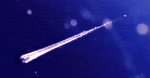 Catching Falling Stardust
25.01.1996
This carrot shaped track is actually little more than 5 hundredths of an inch long. It is the trail of a meteroid through a gel exposed to space in low earth orbit by the shuttle launched EURECA (European Recoverable Carrier) spacecraft.
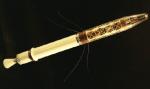 Explorer I
13.02.1998
Inaugurating the era of space exploration for the US, the First Explorer was launched into Earth orbit forty years ago (February 1, 1958) by the Army Ballistic Missle Agency. The Explorer I satellite weighed...
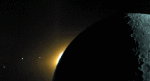 The Ecliptic Plane
29.05.1999
The Plane of the Ecliptic is illustrated in this Clementine star tracker camera image which reveals (from right to left) the Moon lit by Earthshine, the Sun's corona rising over the Moon's dark limb, and the planets Saturn, Mars, and Mercury.
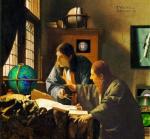 APOD Is Ten Years Old Today
16.06.2005
Welcome to the eleventh year of Astronomy Picture of the Day! In a decade of editing the APOD web pages, the industrious Robert Nemiroff (left) and persistent Jerry Bonnell (right) have enjoyed exploring compelling...
 A Double Eclipse of the Sun
21.03.2015
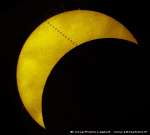
Can the Sun be eclipsed twice at the same time? Last Friday was noteworthy because part of the Earth was treated to a rare total eclipse of the Sun. But also on Friday, from...
 Comet Churyumov Gerasimenko in Crescent
29.04.2015
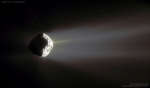
What's happening to Comet 67P/ChuryumovGerasimenko? As the 3-km wide comet moves closer to the Sun, heat causes the nucleus to expel gas and dust. The Rosetta spacecraft arrived at the comet's craggily double nucleus last July and now is co-orbiting the Sun with the giant dark iceberg.
 Discovery in Motion
8.07.2006
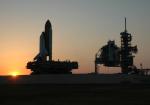
On July 4th, the space shuttle orbiter Discovery rocketed into space on mission STS-121. Now docked with the International Space Station, Discovery orbits planet Earth at about 27 thousand kilometers per hour.
 APOD: 2025 June 14 Б Meteors and Satellite Trails over the Limay River
14.06.2025
What are all those streaks in the sky? A galaxy, many satellite trails, and a few meteors. First, far in the distance, the majestic band of our Milky Way Galaxy runs down the left. Mirroring it on the right are several parallel trails of Earth-orbiting Starlink satellites. Many fainter satellite trails also crisscross the image.
 Beefing Up the International Space Station
17.12.2002
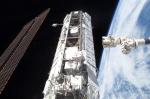
The International Space Station (ISS) will be the largest human-made object ever to orbit the Earth. The station is so large that it could not be launched all at once -- it is being built piecemeal with large sections added continually by flights of the Space Shuttle.
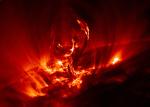 A Solar Filament Lifts Off
25.07.2004
Hot gas frequently erupts from the Sun. One such eruption produced the glowing filament pictured above, which was captured in 2000 July by the Earth-orbiting TRACE satellite. The filament, although small compared...
|
January February March April May June July August September October |
|||||||||||||||||||||||||||||||||||||||||||||||||