
|
You entered: Saturn's Moon
 Eclipse and Ecliptic
9.03.2007
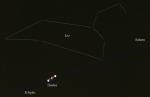
When a Full Moon lies near the ecliptic there can be a lunar eclipse. That cosmic alignment is well illustrated in this composite of eclipse images recorded last Saturday near Paris, France. The projection...
 Sky and Planets
10.03.2000
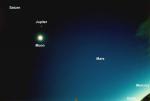
On February 10th, an evocative evening sky above Rocklin, California, USA inspired astrophotographer Steve Sumner to record this remarkable sight - five planets and the Moon. Near its first quarter phase, the bright Moon...
 The Last Moon Shot
17.06.2000
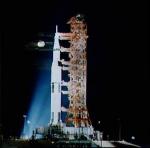
In 1865 Jules Verne predicted the invention of a space capsule that could carry people. In his science fiction story "From the Earth to the Moon", he outlined his vision of a cannon in Florida so powerful that it could shoot a "Projectile-Vehicle" carrying three adventurers to the Moon.
 Crescent Moon and Planets Over Portugal
18.08.2010
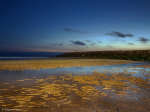
Sometimes, it's fun to share the sky. Although it might appear that the two sky enthusiasts on the ridge are sharing only a crescent moon between them, three bright planets also stand before them.
 The Last Moon Shot
18.10.2003
In 1865 Jules Verne predicted the invention of a space capsule that could carry people. In his science fiction story "From the Earth to the Moon", he outlined his vision of a cannon in Florida so powerful that it could shoot a "Projectile-Vehicle" carrying three adventurers to the Moon.
 The Last Moon Shot
10.12.2005
In 1865 Jules Verne predicted the invention of a space capsule that could carry people. His science fiction story "From the Earth to the Moon" outlined his vision of a cannon in Florida so powerful that it could shoot a Projectile-Vehicle carrying three adventurers to the Moon.
 Moon and Planets at Twilight
28.11.2019
This week's ongoing conjunction of Venus and Jupiter may have whetted your appetite for skygazing. Tonight is the main course though. On November 28, a young crescent Moon will join them posing next to the two bright planets above the western horizon at twilight.
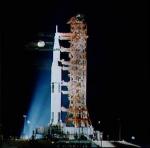 The Last Moon Shot
4.05.1997
In 1865 Jules Verne predicted the invention of a space capsule that could carry people. In his science fiction story "From the Earth to the Moon", he outlined his vision of a cannon in Florida so powerful that it could shoot a "Projectile-Vehicle" carrying three adventurers to the Moon.
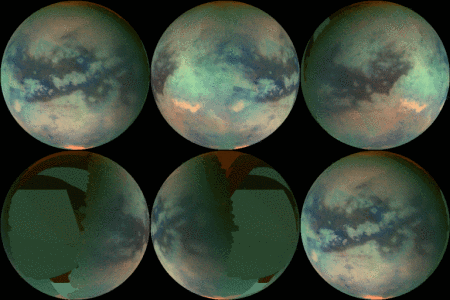 Rotating Titan in Infrared Light
15.02.2006
Titan is one of the strangest places in our Solar System. The only moon known with thick clouds, this unusual satellite of Saturn shows evidence of evaporating lakes created by methane rain. The clouds...
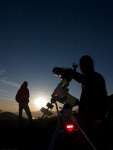 Star Party on Planet Earth
4.04.2009
As twilight sweeps around planet Earth tonight (April 4), many amateur astronomers will set up their telescopes for a 24-hour global star party. The planetwide star party is part of 100 Hours of Astronomy (100HA), a project of the International Year of Astronomy 2009.
|
January February March April May June July August September October |
|||||||||||||||||||||||||||||||||||||||||||||||||