
|
You entered: camera
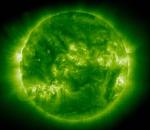 The Iron Sun
29.09.2001
The ultraviolet light emitted by eleven times ionized iron at temperatures over 2 million degrees Farenheit was used to record the above picture of the Sun on September 22, the date of the autumnal equinox.
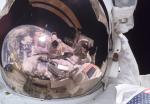 Reflections on Planet Earth
19.07.2006
Catching sight of your reflection in a store window or shiny hubcap can be entertaining and occasionally even inspire a thoughtful moment. So consider this reflective view from 300 kilometers above planet Earth.
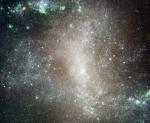 The Star Clusters of NGC 1313
26.01.2007
Like grains of sand on a cosmic beach, individual stars of barred spiral galaxy NGC 1313 are resolved in this sharp composite from the Hubble Space Telescope's Advanced Camera for Surveys (ACS). The inner region of the galaxy is pictured, spanning about 10,000 light-years.
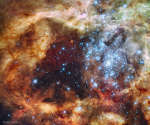 Star Cluster R136 Bursts Out
24.01.2016
In the center of star-forming region 30 Doradus lies a huge cluster containing some of the largest, hottest, and most massive stars known. These stars, known collectively as star cluster R136, were captured in the featured image in visible light by the Wide Field Camera 3 in 2009 peering through the Hubble Space Telescope.
 APOD: 2023 October 16 Б Eclipse Rings
16.10.2023
She knew everything but the question. She was well aware that there would be a complete annular eclipse of the Sun visible from their driving destination: Lake Abert in Oregon. She knew that the next ring-of-fire eclipse would occur in the USA only in 16 more years, making this a rare photographic opportunity.
 Flying Over Asteroid Eros
27.03.2000
What would it look like to fly over an asteroid? Spacecraft NEAR Shoemaker in orbit around asteroid 433 Eros found out earlier this month when it recorded its first fly-over sequence. The saddle region of the Sun-orbiting space-mountain appears to zip past the camera in this condensed hour-long time-lapse sequence.
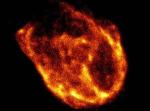 Supernova Remnant N132D in X Rays
13.09.1999
Thousands of years after a star explodes, an expanding remnant may still glow brightly. Such is the case with N132D, a supernova remnant located in the neighboring Large Magellanic Cloud galaxy. The expanding shell from this explosion now spans 80 light-years and has swept up about 600 Suns worth of mass.
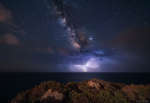 Electric Night
4.12.2019
It may appear, at first, like the Galaxy is producing the lightning, but really it's the Earth. The featured nighttime landscape was taken from a southern tip of the Italian Island of Sardinia in early June.
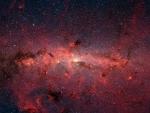 Stars of the Galactic Center
13.01.2006
The center of our Milky Way Galaxy is hidden from the prying eyes of optical telescopes by clouds of obscuring dust and gas. But in this stunning vista, the Spitzer Space Telescope's infrared cameras, penetrate much of the dust revealing the stars of the crowded galactic center region.
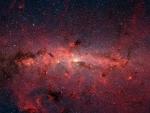 Stars of the Galactic Center
10.02.2007
The center of our Milky Way Galaxy is hidden from the prying eyes of optical telescopes by clouds of obscuring dust and gas. But in this stunning vista, the Spitzer Space Telescope's infrared cameras, penetrate much of the dust revealing the stars of the crowded galactic center region.
|
January February March April May June July August |
||||||||||||||||||||||||||||||||||||||||||||||||||||||||